

CDFIs: The old new thing
CDFIs are America’s unsung treasure, financing affordable housing and small businesses where conventional banks have pulled back or never lent. Yet bank consolidation, proposed federal funding cuts and efforts to weaken Community Reinvestment Act incentives threaten their funding.
This article argues that philanthropy should look to these established lenders before creating new vehicles. Their community knowledge and lending experience make them natural partners for foundations seeking to expand access to finance.
CDFIs are America’s unsung treasure, financing affordable housing and small businesses where conventional banks have pulled back or never lent. Yet bank consolidation, proposed federal funding cuts and efforts to weaken Community Reinvestment Act incentives threaten their funding.
This article argues that philanthropy should look to these established lenders before creating new vehicles. Their community knowledge and lending experience make them natural partners for foundations seeking to expand access to finance.

Things To Know Before You Head Down the Revenue Road
With foreign aid and government funding contracting, NGOs face tougher competition for grants even as demand for their services rises. Many are seeking new revenue sources to strengthen sustainability, but diversification is rarely a straight path. This article examines when, whether, and how NGOs can pursue it effectively.
Foreign aid is contracting. So is government funding. Grant competition is intensifying. Yet for many NGOs, the demand for their services is only expanding, amplifying their need for financial resources. As a result, NGOs are exploring how to generate revenues that can make them more financially sustainable.
The transition from grant dependence, however, can be a resource intensive process in which success is partial and often reversible. In this article, Chris Walker and Jerome Tagger look at why diversification journeys are rarely linear, when the most strategic choice is not to diversify at all, and how boards can make more realistic decisions about revenue generation.
It’s a long and winding road
Many years ago, we worked with a grant‑funded social enterprise that sold basic health products to low‑income communities in Latin America. For many good reasons, its leaders were eager to graduate from grants: they wanted to swap in loans, scale more quickly, and prove they could cover their own costs. They drew up a business plan, raised capital, and started rolling out a network of small storefronts, expecting sales from those shops to pay for rent, staff, and logistics.
That's when the real costs showed up: operations ran high, margins ran thin, and prices had to rise. Their poorest customers were priced out, forcing a hard choice: chase financial self-reliance through loans and higher prices, or hold the line on serving the poorest and accept that grants would remain part of the picture.
This NGO’s story, unfortunately, is all-too-common, as are the questions it raises: Which NGOs should diversify? Under what conditions? At what cost to mission, time, and capacity?
For some, earned income will never be a meaningful funding source. For others, it can expand impact and resilience. Distinguishing between these paths early is critical. The wrong transition consumes scarce leadership attention and weakens core programs.
Revenue diversification that stays mission-aligned doesn't follow a neat formula. It's iterative, shaped by market feedback, internal tradeoffs, ecosystem constraints, and organizational capacity. Founders and leaders will do well to adopt an experimental approach: sketch a model that seems reasonable for their context, test it with partners and funders, learn where it collides with reality, adjust, rinse, repeat.
One Acre Fund offers a good example of such a deliberate approach. Early on, the organization set itself a clear target: make its field operations fully financially self‑sustaining so that donor dollars could be freed up for other priorities.
As it pushed toward that goal, it ran into a by now familiar tension: the closer it got to full cost recovery, the harder it became to stay focused on the very poorest smallholder farmers. Over time, One Acre Fund reframed what it meant by sustainability, putting more weight on cost efficiency and on using revenue from better‑off customers or programs to subsidize harder‑to‑serve markets.
More recently, One Acre Fund has gone a step further and moved away from pursuing financial sustainability across the board. Instead, it has invested in developing "revenue engines," impact initiatives that can also generate earned revenue and that have the potential to become fully self-sustaining. This represents a shift from viewing sustainability as an organization-wide goal to embedding it within specific, scalable program models, a reflection of the learning curve that One Acre Fund followed on its path to diversification.
When the less traveled road is less traveled for a reason
Focusing on such success stories (which are few and far between) risks missing how things play out for many organizations. In our work, a lot of the real learning has come from decisions not to move ahead.
We have worked with NGOs that explored fee-for-service models, training products, membership or subscription models or standalone commercial ventures – and a range of combinations – with real seriousness.
Many then chose to stop. In some cases, the conclusion was straightforward: the revenue that might be generated was too small or too uncertain to justify the investment of leadership time, staff energy, and political capital. In others, the concern was mission drift: the new activity would have pulled the organization toward a different audience or a different theory of change. Often, management bandwidth was the binding constraint: there was no realistic way to build and run a new revenue line while also delivering on existing commitments to communities and funders.
These largely invisible choices reflect boards and leadership teams treating diversification as high stakes strategic transformation, with all its implications, rather than as an assumed next step. Across cases, similar tensions show up: Business model change is layered on top of full plates, with program leaders asked to think about pricing and customer segments while still delivering outcomes for donors. Finance teams are asked to model new instruments using systems built for grants. The closer a revenue model comes to reshaping who pays and who benefits, the sharper the mission questions become: are we asking our primary constituents to pay for something that used to be subsidized, or privileging those who can pay over those who most need the service? Government partners, local NGOs, and communities notice when an organization changes how it talks about money; some welcome it, others read it as a shift toward something more transactional.
Choosing the route with eyes wide open
The first conversation should be about whether a business model shift makes sense at all, given mission, context, and organizational capacity. In some situations, the most strategic move may be to focus on improving the quality and predictability of grant funding, building reserves, or deepening alliances, rather than launching a new business line.
From there, fit must sit at the center. In this context, with this mission, this team, what types of revenue are plausible? To guide that discussion, NGO leadership might consider questions such as:
● Market fit: Are there for-profit or nonprofit competitors already serving this market, and how might their presence influence success?
● Customer behavior: Would selling rather than giving away a service strengthen engagement, loyalty, or customer feedback loops?
● Organizational readiness: Do key staff have the necessary business or financial management expertise or the right commercial mindset? If not, is the organization willing to hire or train to fill those gaps?
● Costs vs. benefits: Does the organization have a reasonable path to making money? Do the profits exceed the cost of transformation? Are there ways to cut costs that would reduce the need for revenues?
● Mission alignment: How would this new activity support or dilute the organization’s purpose and impact goals?
● Implications for governance and relationships: How might a new line of earned revenue change how impact is measured, how decisions are made, or how the organization relates to its partners and communities? For instance, can you answer the critique of “Why are you trying to make money off the backs of the poor”?
● Risk appetite: Can you reverse course easily if your revenue-generating approach fails, and how will you manage the consequences?
Boards and leadership teams that approach these questions systematically are better positioned to distinguish between feasible diversification pathways and those that may distract or overextend. Crucially, they can avoid magical thinking.
And while we noted earlier that these journeys are rarely linear, it bears repeating transitions like this are rarely tidy. They ask organizations to learn as they go—about markets, about internal capacity, and about how far a mission can stretch without losing its center. The real work is about making thoughtful choices and staying anchored in purpose even as the organization’s shape begins to change.
The social enterprise we began with demonstrates this learning journey. Drawing on its own experience, it opted to pursue its mission of serving the poorest over its goal of financial sustainability. It did not, however, revert to the status quo. Instead, it turned those lessons into a new guiding metric for the organization - the cost per product delivered - and pushed itself to lower this cost over time. By showing donors it was intentionally stretching every grant dollar further, it became a more attractive funding opportunity and clearer about its primary mission.

Business Relativity: Where Competitive Advantage Survives in the AI Economy
In Business Relativity: Where Competitive Advantage Survives in the AI Economy, we argue that AI is collapsing the value of “making” knowledge work and shifting advantage to those who certify, own, and are accountable for outcomes. We also propose tools for leaders on the path to transformation.
The Agency Owner Who Could Not See
Sarah[1] had built the agency over nine years. Two employees, a steady client base, a reputation for honest work. Sarah built websites, managed ad campaigns, ran social media, handled basic SEO. The work was good. The clients were satisfied. The numbers looked fine.
Then, the phone stopped ringing the way it used to. Proposals that once closed in a week lingered for three. Two long-standing clients moved work in-house, citing tools they could not quite name. A prospect told her, candidly, that her price for a website redesign was “more than we want to spend now that we have other options.”
Sarah did not know what the other options were. She did have a suspicion.
One afternoon she called Ray, a retired consultant who had seen a lot of markets shift.
“My numbers aren’t falling off a cliff. But something is wrong. I just can’t put my finger on it.”
Ray was quiet for a moment.
“Tell me what you did for clients last week. Specifically.”
“Built out a website for a restaurant group. Managed three ad campaigns. Wrote social content for a law firm. Basic SEO for a dentist.”
“And what did clients actually pay you for in those engagements? Not what you delivered. What they were buying.”
Sarah did not have a good answer. That was the beginning.
“Here is what I see. You have been selling what you produce. The only people still getting paid well in your world are the ones who sign off on what a machine produced. They are not selling output. They are selling accountability.”
Sarah wrote it down.
Sarah’s business was not failing. It was eroding. And she had no framework to explain why. What she lacked was a way to see that the ground beneath her advantages had shifted.
Sarah’s situation is not unusual. In 2023 and 2024, large law firms reported a familiar but uncomfortable pattern: demand remained strong, but clients pushed back on what they would pay for routine work. Firms hired fewer associates relative to partners and used generative AI to complete research, drafting, and document review faster.
Productivity per lawyer rose; Pricing power for the underlying tasks did not. In customer operations, controlled field studies show productivity gains of 30% or more from generative AI, with the largest improvements among less-experienced workers. In software development and marketing, common professional tasks now take a fraction of the time previously required. In large professional-services firms broadly, hiring for entry-level analytical roles has slowed even as revenues have grown. Productivity rises while the price of the work declines.
These developments are often described as a technology story. They are more accurately an economic one. For decades, firms created competitive advantage by controlling the capacity to produce high‑quality cognitive output at scale. As AI collapses the cost of that production, advantage migrates from making the work to certifying it: bearing consequences for whether it is correct. This article explains that shift from production to certification, identifies the five conditions that still create durable pricing power, and offers a practical audit for locating your own work on the right side of the boundary.
Strategy Under New Boundary Conditions
Traditional business strategy assumes that producing high-quality cognitive output is expensive, therefore, scarce. Training a lawyer takes seven years. A competent financial analyst requires years of modeling experience. A skilled copywriter develops craft through thousands of hours of practice. That training is expensive and used to be impossible to shortcut. The constraint created scarcity. The scarcity supported pricing power. The classic playbook of differentiation, scale advantages, experience curves, and reputation worked because capability was difficult to acquire and difficult to reproduce.
AI collapsed the cost of that production toward zero. A well-prompted language model produces marketing copy, financial summaries, legal document drafts, research syntheses, and strategic analyses in seconds, for pennies. While not artisan quality, it is good enough for most. And good enough at near-zero cost destroys pricing power.
As Clayton Christensen, the Harvard professor, observed in The Innovator’s Dilemma, the disruptor prevails not by outperforming the incumbent on traditional metrics but by offering something more affordable and accessible. Once performance becomes good enough for the mainstream, the basis of competition shifts and the incumbent’s historic advantages become irrelevant. AI is that disruptor in knowledge work, and it is not compressing one tier of cognitive output but two tiers simultaneously, leaving less time for adjustment than any predecessor technology allowed.
Three Tiers of Knowledge-Work Output
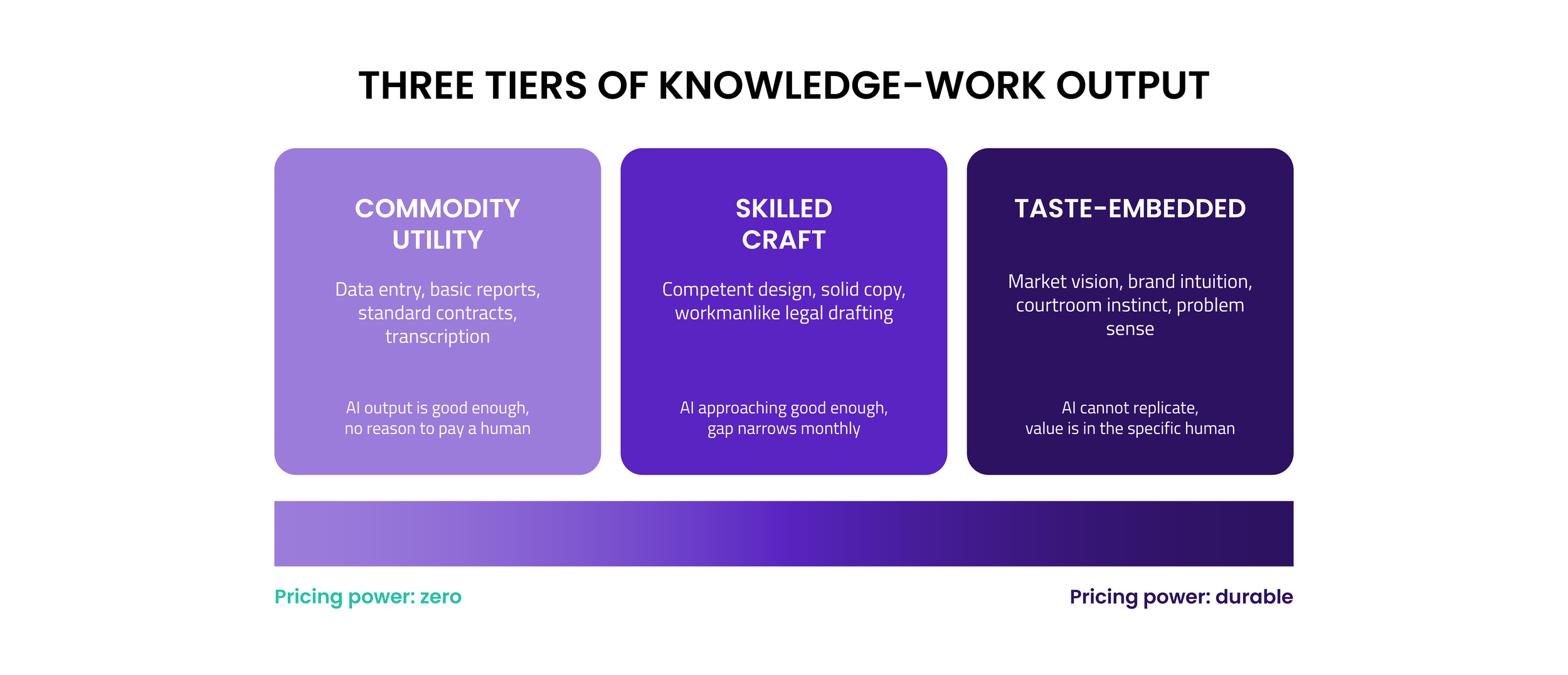
Figure 1: Three tiers of knowledge-work output. AI’s impact varies dramatically across tiers.
At the bottom, commodity utility output (data entry, standard financial reports, basic legal documents, transcription, routine correspondence) is where AI is already good enough. No client will pay a professional rate for work a machine does acceptably at trivial cost. The scarcity is gone.
In the middle, skilled craft output (competent website design, solid marketing copy, workmanlike legal drafting, mid-tier consulting analysis) is where AI is approaching good enough, and the gap narrows every month. Most knowledge professionals operate here. This is also where anxiety runs highest, because these professionals can see the water rising.
At the top, taste-embedded output resists automation entirely. Any first-year analyst today has more raw power than Warren Buffett in his prime: more information sources, better modeling tools, 24-hour reporting on companies. Buffett, however, sees things almost all analysts never will. When he read Geico’s financials in 1951, or recognized Coca-Cola’s brand as an unassailable moat in 1988, he was not doing more efficient analysis. He was doing categorically different work. This type of insight has yet to be replicated, or trained, despite countless efforts and costly MBAs.
AI commoditizes utility output. It does not commoditize taste-embedded output, because taste is not a production process. It is an accumulation of judgment that expresses itself through choices no algorithm can reverse-engineer.
The Core Shift: From Production to Certification
AI made production cheap. Certification is still expensive. Everything else in this article follows from that.
In the traditional model, value accrued to the party that could produce reliable output: the firm that could research, analyze, draft, and deliver under deadline at acceptable risk. AI dismantles that structure. It makes the production layer cheap and abundant, while leaving the consequences of errors fully intact. The scarce resource is no longer the ability to do the work. It is the willingness to bear personal consequences for the work’s correctness.
A machine can generate an audit workpaper. It cannot sign the audit opinion. It cannot be disciplined by a professional body, sanctioned by a regulator, or sued for malpractice. As AI handles more of the production, the humans who certify, sign, and stand behind the output become more valuable, not less. The fewer people needed for production, the higher the margin on certification.
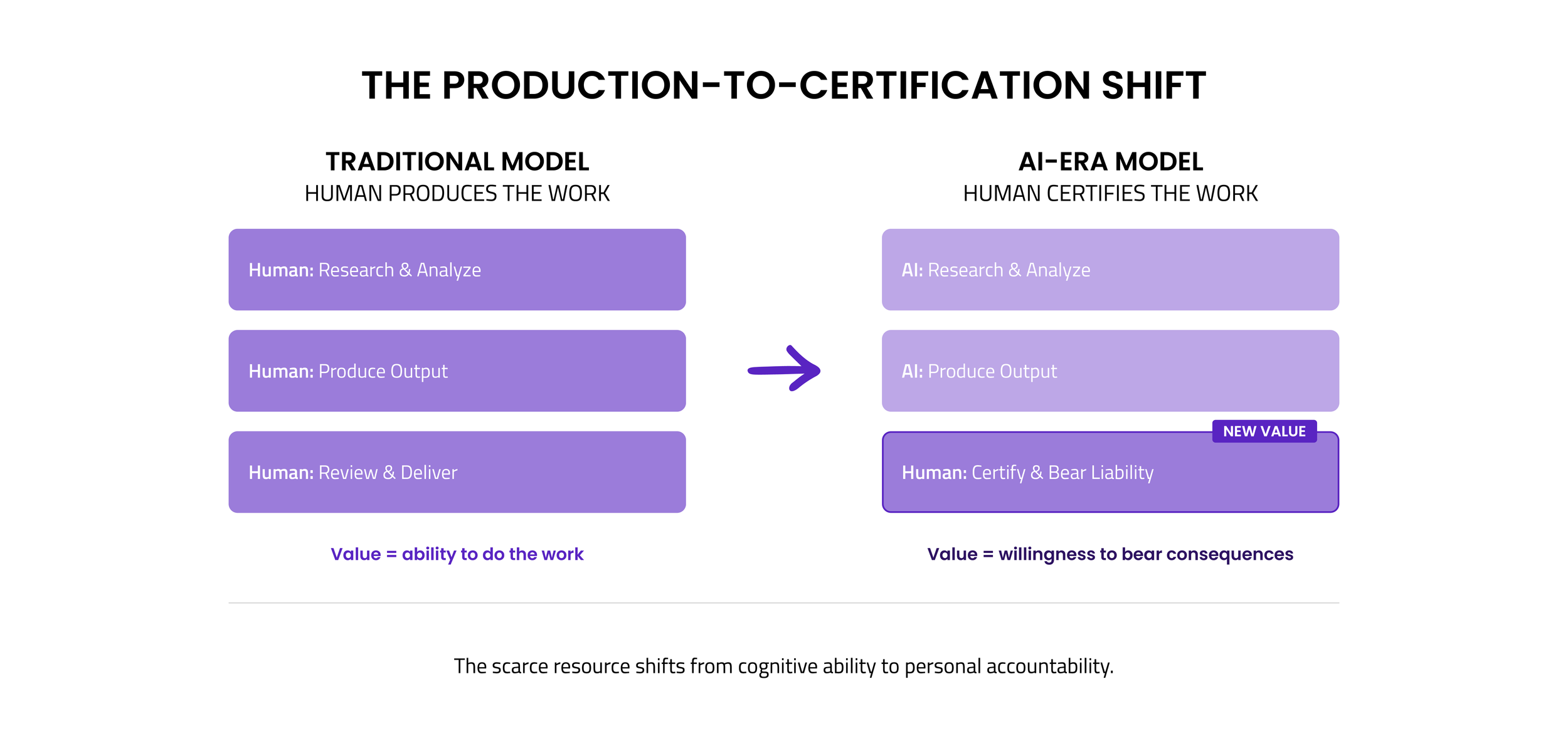
Figure 2: The scarce resource shifts from cognitive ability to personal accountability.
Professional pyramids are shrinking at the base. While the proportion of law firm associates fell from 44.5% to 40.2% over the last fifteen years, generative AI is now accelerating this collapse. Headcount at the bottom is compressing because firms no longer require a fleet of juniors for first draft production. This shift allows margins to expand even as the price of routine work declines. The labor cost of production is falling faster than the market price for senior level certification. PwC provides a clear example; the firm aims to reduce junior hiring by one third by 2028. In this new economy, drafting and synthesis are commodities. Senior roles remain valuable because human judgment and legal accountability are the only remaining scarcities..
Five Sources of Durable Scarcity
Certification can take five forms, each of which represents a source of pricing power that persists when production costs approach zero.
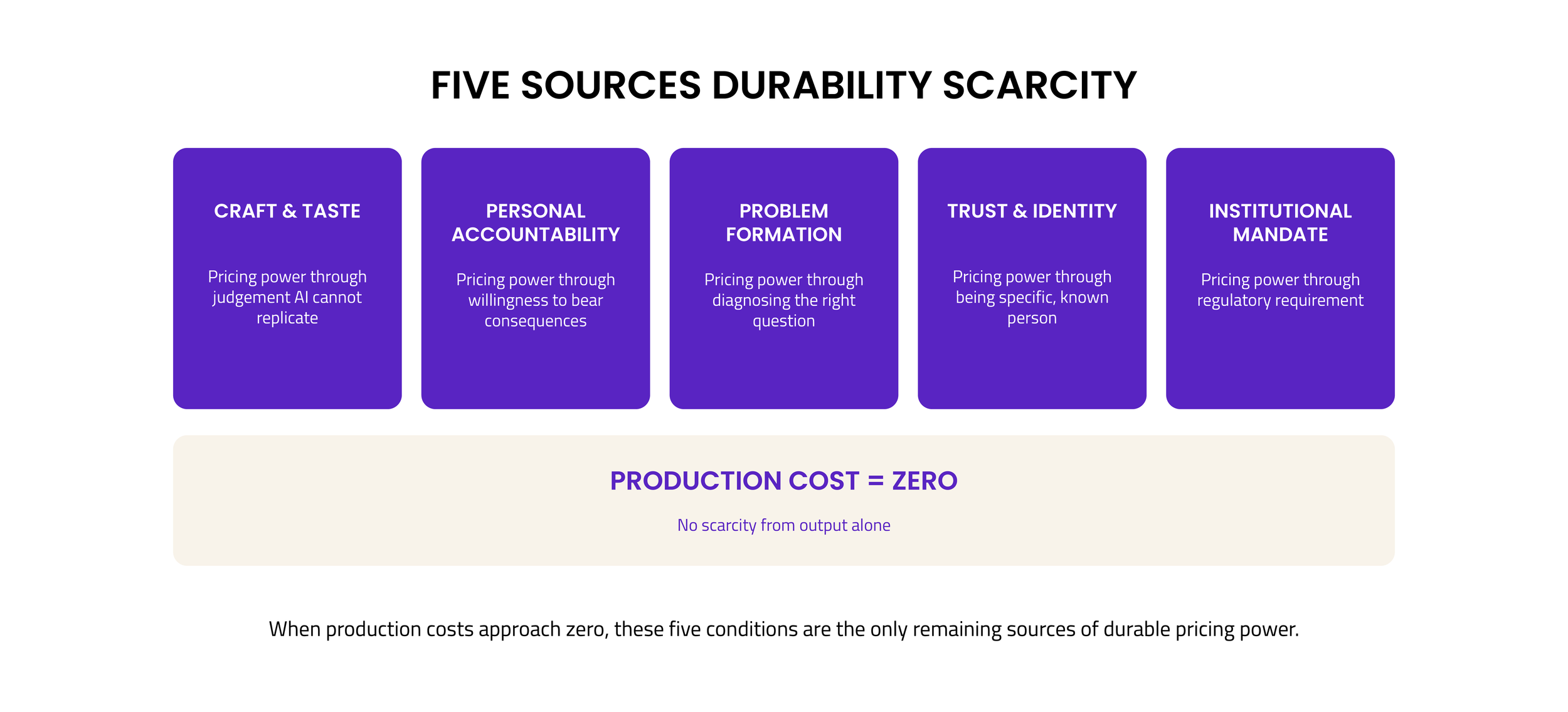
Figure 3: When production costs zero, these five conditions are the only remaining sources of durable pricing power.
1. Craft and Taste
In any field, there is a difference between producing something functional and producing something that reflects hard-won discernment. In knowledge work, that discernment appears as strategic intuition, market vision, and interpretive skill built through experience and expressed through choices that cannot be reduced to a prompt. As competent output becomes ubiquitous, differentiated judgment becomes more valuable. The strategic implication: price around the decisions that shape outcomes, not around standardized deliverables.
2. Personal Accountability
Certification is not review. It is responsibility. A CPA’s signature has always been valuable. In the AI economy it becomes more valuable, because AI generates the workpapers but cannot sign the opinion. When errors carry meaningful consequences, the willingness to bear those consequences becomes scarce. The strategic directive: stop selling what you produce. Start selling what you are willing to be held accountable for.
3. Problem Formation
AI performs well when the task is clear. It struggles when the problem is not yet defined. The highest-value advisory work is often not solving a known problem but identifying the right one: the problem behind the problem. This is when a “marketing issue” becomes a positioning problem, or a “growth slowdown” is revealed as a trust deficit in the product. When AI handles downstream analysis, upstream diagnosis becomes the scarce capability. In many contexts, knowing how to write the AI prompt is the work.
4. Trust and Identity
AI agents are interchangeable. They have no history, no continuity, no reputational skin in the game. The counterparty matters in consequential decisions: selling a company, restructuring an organization, allocating capital. The value lies in the outcome and the reputational collateral attached to the person providing it. Leaders should treat trust and continuity not as soft factors but as assets that sustain pricing power when output becomes abundant.
5. Institutional Mandate
Regulation, licensing, and professional standards change more slowly than technology. Courts require licensed attorneys. Audits require certified accountants. Many clinical decisions require credentialed professionals. These requirements create durable scarcity because the supply of licensed humans grows slowly while the demand for certification of machine-generated work grows quickly. If you operate in a regulated knowledge profession, your license is becoming your most valuable asset. Protect it, leverage it, and price around it.
The Audit: Five Questions to Ask
Most organizations now operate across two modes of work: Data gathering, analysis, drafting, modeling, and execution, production, is rapidly moving into the AI model, where productivity rises and the work commoditizes. The other, where value is shifting towards, is certification: the human responsibility for judgment, trust, and decisions. A consulting firm may automate slide production, but its boardroom judgment still carries the risk. A financial planner’s modeling may commoditize, but the fiduciary relationship remains. A marketing agency’s campaign execution can be automated; brand judgment still depends on people.
The professionals who recognize this split and deliberately migrate their time toward the human-regime activities will build durable careers. The ones who keep spending most of their time on production will find that time worth less every quarter.
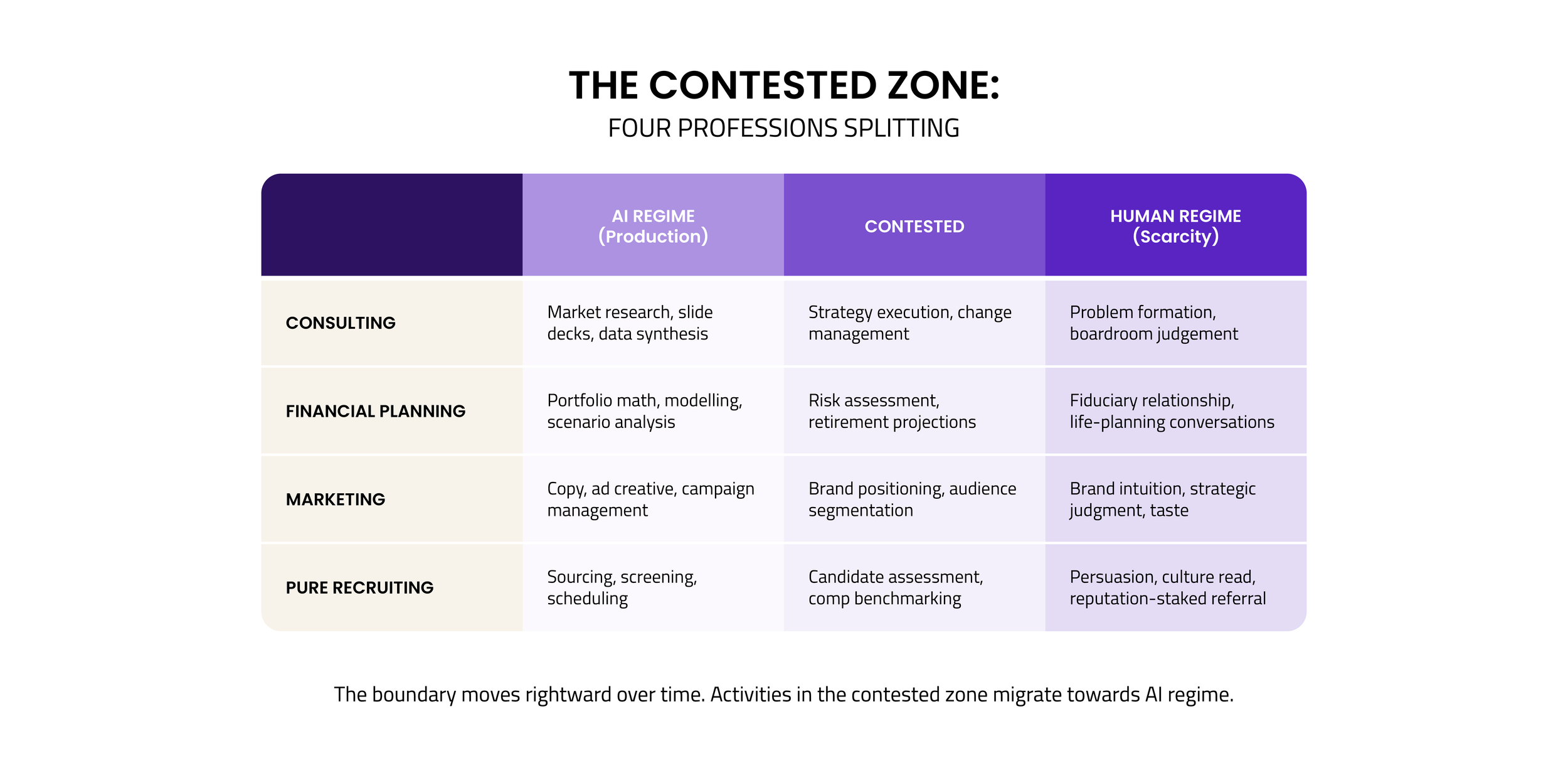
Figure 4: Four contested-zone professions splitting along the same fault line. The boundary moves rightward over time.
Here is how to apply this framework. List every activity from last week that generated revenue or served a client. Be specific. Not “marketing consulting” but “built a competitive analysis deck,” “led a strategy session with the CEO,” “wrote three blog posts for a client,” “reviewed and corrected a junior associate’s AI-generated deliverable.”
Score each activity on a scale of 1 to 5:
1. Could AI produce this output at 80% of the quality? (1 = no, 5 = easily)
2. If this work contained a serious error, would it carry personal consequences for me? (1 = no real consequences, 5 = severe)
3. Was the problem well-defined before I started, or did I have to discover it? (1 = I had to discover it, 5 = it was handed to me clearly)
4. Does the client care that I specifically did this? (1 = it had to be me, 5 = anyone would do)
5. Does a regulation or institutional norm require a human? (1 = yes, strictly, 5 = no requirement)
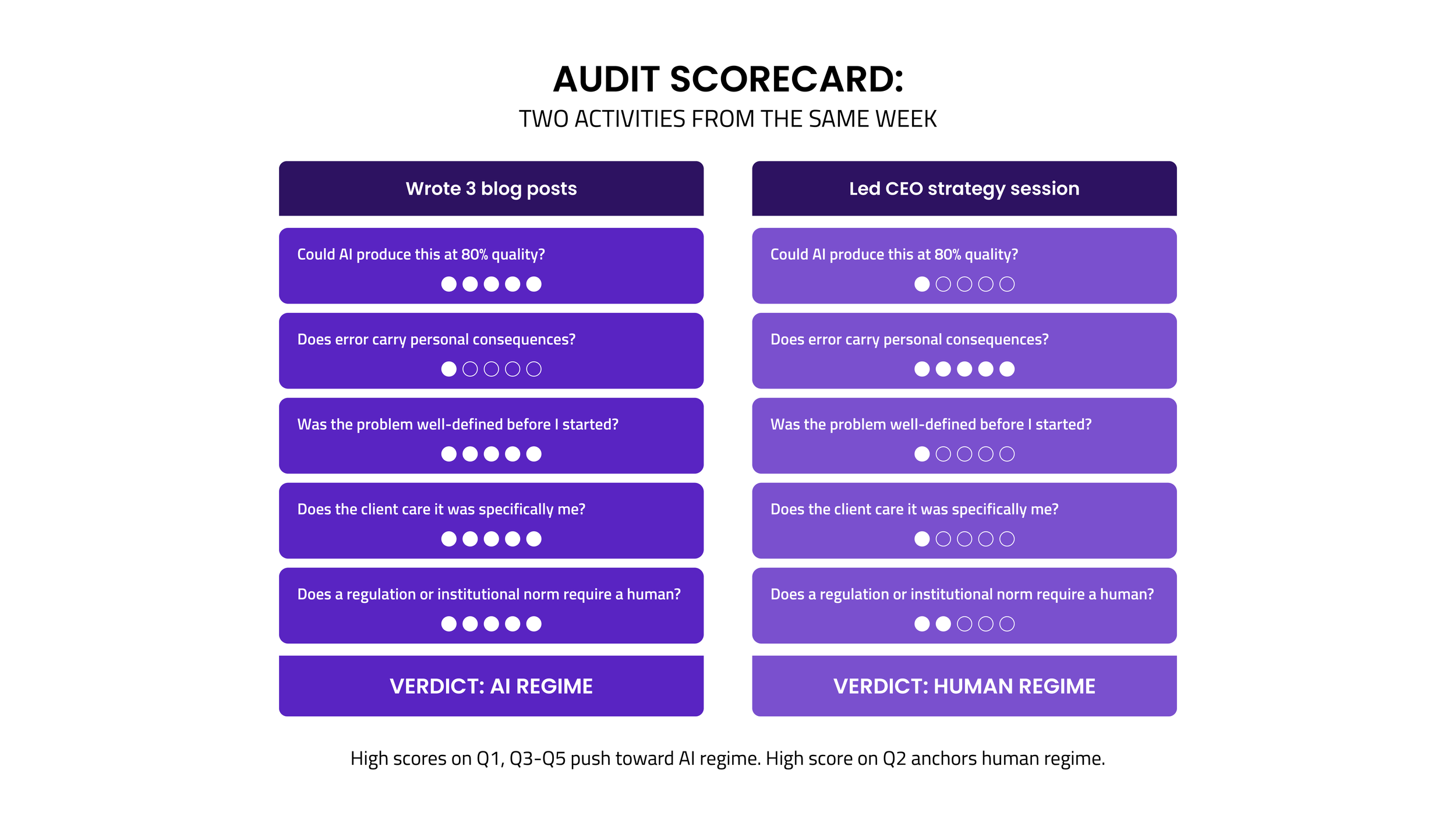
Figure 5: Two activities from the same week. One is deep in the AI regime. The other is anchored by multiple scarcity conditions.
Activities that score high on question 1, high on questions 3 through 5, and low on question 2 are in the AI regime. Activities that score low on question 1, high on question 2, and low on questions 3 through 5 are anchored by scarcity conditions. Everything in between is contested.
Now calculate your time split. What percentage of your revenue-generating time last week fell into each category? If more than half is in the AI regime, the urgency is real. That portion of your work is on a countdown measured in months, not years.
The final step is a decision. Pick the single AI-regime activity consuming the most of your time. Either automate it or stop offering it. Then pick the single activity where you are most anchored by scarcity conditions and ask: how do I do more of this? How do I price and position it so that clients understand they are paying for my judgment and accountability, not my output?
What Leaders Should Do Next
If you find yourself scoring poorly on the audit, there are three concrete moves that accelerate the production-to-certification shift:
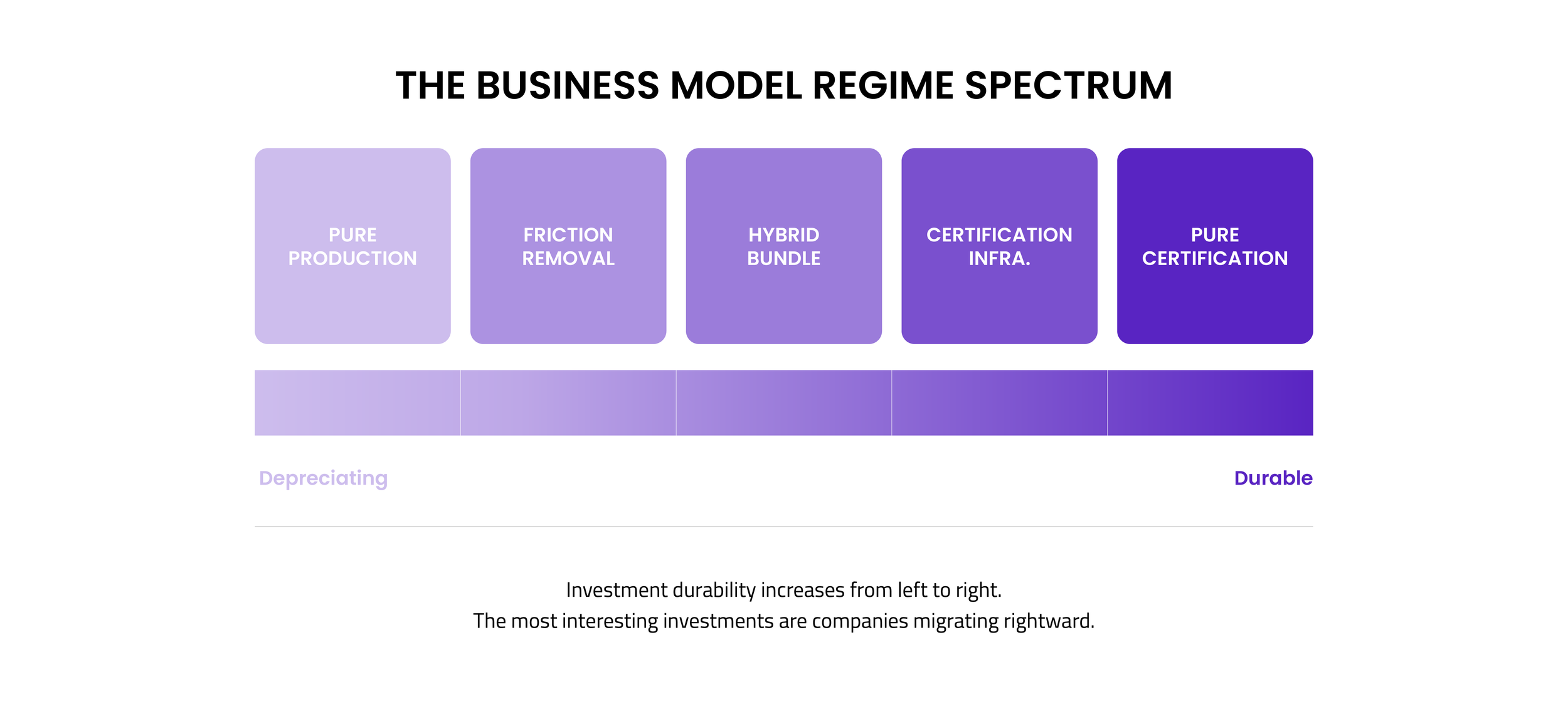
Figure 6: Investment durability increases from left to right. The most interesting positions are companies migrating rightward.
Reprice away from deliverables and toward consequences. If the work is easily produced, pricing based on production will face pressure. Pricing based on validated correctness, risk reduction, and decision ownership is more durable.
Redesign roles around review, escalation, and sign-off. Many knowledge organizations still staff for production. The new bottlenecks are quality assurance, exception handling, and accountable decision rights. Invest in the layers that certify work, not the layers that generate first drafts.
Separate production systems from certification systems. Trying to preserve a production business model while adopting AI produces confusion: teams optimize for speed while clients demand accountability. Build explicit pathways. Automation for commodity production. Human-in-the-loop certification for consequential outputs.
What Sarah Finally Saw
Six months after that call with Ray, Sarah called him again.
“I stopped selling website builds as a standalone service. I let a junior handle the production. I’m pricing my time around the strategy, the positioning work, the oversight.”
“And?”
Ray asked.
“Headcount went from three to one. Revenue dropped a third in the first quarter and recovered by the third. Margin doubled.”
“You stopped competing with tools.”
“I stopped competing with tools.”
Sarah’s window existed because most practitioners in her space had not yet made this transition. They were still producing, still competing on output quality and turnaround time against a technology that produces faster and cheaper every month. That window will not stay open forever.
Not Doom. Clarity.
The old rules are not wrong. They are a special case. They still apply wherever craft, accountability, problem formation, trust, or institutional mandate creates scarcity. In those domains, the competitive playbook that has worked for decades continues to work, modified for a world where AI handles production, but humans still certify, interpret, relate, and bear consequences.
The common mistake is treating AI disruption as a uniform force that either threatens everything or threatens nothing. It is neither. It is a boundary condition. The task is to determine which side of that boundary your work occupies, and to restructure before the boundary moves past you.
Revenue anchored in scarcity conditions becomes less substitutable, less labor-linear, and more durable. That is the combination capital markets reward with structurally higher valuations.
The strategic task for every knowledge-intensive organization is to locate each activity on that boundary and reallocate time, pricing, and operating model toward the sources of scarcity.
[1]Sarah is a composite character drawn from interviews with agency owners conducted by the authors. Her name and identifying details have been altered.

How foundations can support nonprofits in M&A
Nonprofits are under growing pressure to do more with less, and thoughtful mergers and alliances can be powerful tools for resilience rather than signs of failure.
This article outlines how foundations can normalize and finance nonprofit M&A across exploration, transaction, and integration, providing the capital, cover, and expertise leaders need to pursue structural change in service of long-term impact
As nonprofits confront rising pressure to deliver impact with constrained resources, leaders increasingly recognize collaboration, merger, and consolidation as strategic tools for resilience and continuity. Yet fear of reputational risk, internal disruption, and funder misinterpretation too often keeps these options trapped at the level of theory rather than action.
Nonprofit mergers and alliances (M&A) fails less because of weak strategy or unwilling leaders, and more because philanthropy has not normalized, financed, or legitimized structural change as a responsible form of stewardship.
Nonprofit leaders are often deterred from even considering M&A out of concern for how it will affect their funding relationships. Many foundations effectively control “survival capital,” and a proposal to explore a merger can be misread as an admission of failure rather than prudent stewardship, even when the underlying motivation is long-term impact and stability.
This perception gap constrains action. Funders, boards and executives may toy with the idea of a merger informally but stop short of commissioning real feasibility work or engaging potential partners in depth. The risk to reputation feels too high, and the capital to explore options is too scarce. In this environment, foundations have an unusually important role to play, not only by supplying money, but by signaling their support for exploration, and, in doing so, for demonstrating that structural change can be a mark of strategic maturity.
The other significant constraint to M&A in the sector is the lack of resources. Nonprofit M&A exists on a spectrum: on one end sit lighter-touch alliances and partnerships—shared services, joint programs, co-location—that many organizations can pursue with modest incremental support. The other end is full mergers and complex affiliations, where assets, liabilities, and leadership roles are reconfigured. It is in this heavier zone that philanthropic finance becomes most critical, because most nonprofits simply do not have sufficient flexible funding in their budgets to pay for external expertise that can facilitate the success of mergers.
That missing infrastructure shows up in four recurring gaps, each of which is, at bottom, a financing issue:
The first is bandwidth: Nonprofit staff are already stretched thin trying to maximize their impact with resources that never seem sufficient for the challenge they’re addressing. Without funding to bring on external support, executives are forced to treat complex transactions as side projects.
The second gap is expertise. Specialized legal, financial, and technical advice is essential to structure deals that are fair and transparent, but it is rarely budgeted. Dedicated dollars for M&A counsel, financial modeling, and due diligence help boards understand what they are taking on and protect all parties involved.
The third gap is neutrality, which also has a financial dimension. Trusted, neutral facilitators, people with no stake in which organization “wins”, rarely come for free. Funding for these roles makes it possible to surface and work through sensitive questions about power, leadership, and brand without derailing the process.
The fourth gap is capital itself. Beyond professional fees, real money is required to merge systems, integrate or exit leases, harmonize benefits, and resolve one-time obligations such as severance or debt. These are transition investments: targeted, time-bound grants can cover them without permanently inflating operating budgets.
Because these gaps emerge at different points in the journey, finance must follow and support the pace and lifecycle of the combination or merger. In the exploration phase, external support is needed to facilitate “first dates”: facilitation of confidential board-to-board conversations, high-level feasibility assessments, and structured needs assessments that ask whether M&A is really the right tool - and in what form. The financial needs at this stage are relatively small, but they unlock disciplined decision-making by providing analysis and process design that nonprofits may not otherwise undertake.
One practical implication is that funders can reduce risk by breaking support into phases and tying subsequent tranches to clear milestones, thereby highlighting that investing in the merger’s success protects the funder’s mission and ensures service continuity.
If the parties decide to move forward, transaction-stage needs come to the fore. At this point, costs become more concrete and finance is used to de-risk the mechanics of the deal: legal drafting and due diligence, financial reviews, communications and rebranding work, and convenings of boards and senior staff. By explicitly covering these hard costs, funders reduce the temptation to cut corners, whether it’s skipping stakeholder engagement, rushing legal review, or underinvesting in change management.
The final phase is integration, which is often where under-financed mergers falter. This is the slow work of actually becoming one organization: merging HR and IT systems, aligning pay and benefits, integrating cultures and values, and building new routines for learning and accountability.
The needs look different from core operating support: declining over time and focused on one-time or front-loaded costs like system migrations, team-building, and temporary duplication during transition. When foundations commit to this kind of support, they help ensure that the merger’s promised efficiencies and impact gains are actually realized.
Throughout all three phases, funders can blend their financial capital with other forms of capital. Social and temporal capital can be deployed by using networks to make introductions between potential partners, convening peers who might otherwise see each other only as competitors, or relaxing grant timelines and reporting demands to give leaders the time they need. Moral and operational capital can be just as important: publicly validating well-considered mergers, providing boards with political cover, and sharing expertise on HR, finance, operations, IT, or evaluation so that grantees are not handling complex integrations alone.
When foundations provide both the resources and the license to reconsider organizational form, they help make transformation a normal part of nonprofit life rather than an emergency measure of last resort. Crucially, they also make it a normal part of philanthropy, reinforcing the effectiveness, impact, and credibility of the sector and the nonprofit ecosystem it supports.

Nonprofit M&A: A Guide for the Perplexed
This Guide for the Perplexed offers a practical cheat sheet to mergers, affiliations, and program transfers for nonprofits. By focusing on structure, fit, and execution—from early exploration through integration—it shows how boards and executives can make disciplined, mission-first choices that protect stakeholders, support leadership, and increase long-term impact.
A practical guide to mergers, affiliations, program transfers, and the many ways nonprofits can do what’s best for the mission.
Nonprofit mergers and alliances are often treated as a last resort: a move you make when something has gone wrong. They can feel like an admission of failure. In practice, consolidation is often a sign of discipline. It can be a deliberate strategy to increase scale, extend reach, or place a mission on a more durable platform. In some cases, growing larger builds resilience. In others, simplifying or shrinking back is what protects the work.
One principle cuts through all of this: size does not matter; mission does.
The real question is structural. Is your current organization the best vehicle to carry the mission forward? If joining forces allows you to serve your community more effectively than standing alone, then M&A is not a white flag. It is fiduciarily responsible stewardship, and often the most responsible choice a board and leadership team can make.
At its core, nonprofit M&A is about design. It asks whether parallel efforts should remain separate, or whether alignment would produce greater impact. When resources are constrained, needs are rising, and funders increasingly expect collaboration, structure matters as much as strategy and programs.
Because this work is rarely straightforward, and often feels opaque to boards and executives, we have put together this primer to demystify the process. Think of it as a field guide: what to expect, what to watch for, and how to approach consolidation as a strategic practice.
We break that process into four stages:
The Fuzzy Front End
Tactical Targeting
Negotiation
Implementation
I. The Fuzzy Front End
Every successful nonprofit combination begins long before anyone uses the word “merger.” It begins with a habit of honest inquiry, and one big question: Could (Should) we do this better together?
The fuzzy front end is about building that habit into the organization’s governance, operations, strategy, finance and culture. Instead of waiting for crisis, leaders create space for routine strategic review, asking important questions, including:
How is the field shifting?
Where are we duplicating effort?
Are we too small to meet rising expectations?
Who could help carry the mission farther?
Would combining strengthen outcomes?
Some organizations formalize this through a standing Chief Strategy Officer or partnerships group, a cross-functional team that blends program insight, community voice, HR, D&I, operations, and executive leadership. The group’s job is to ask better questions about how the organization can best complete its mission. Those questions often lead to the same core motivations that drive nonprofit M&A:
Mission alignment: Someone else can help advance it more effectively.
Capacity gaps: You need infrastructure you can’t build fast enough.
Field disruption: Old models break; new models emerge.
Succession: Stewardship sometimes means passing the baton, not preserving the banner. (For a good read on this, see this article by Allie Burns).
Having Mergers & Alliances as a consistent focus of the strategy/leadership team builds the governance habits, strategy cadences, and organizational muscle memory that make exploration normal. M&A affects mission delivery, community trust, and staff culture. Program leadership, community engagement teams, HR, D&I, Finance and executive leadership all belong in the conversation.
II. Tactical Targeting
Once the board agrees to explore M&A, the work shifts from philosophical to analytical. The goal is to identify partners whose mission, finances, culture, and community relationships make a combination genuinely additive, and worth the effort of integration.
1. Clarify why you’re exploring M&A: Align board, leadership, and key funders on the primary goals:
Expand reach or geographic footprint
Improve program quality or depth of services
Strengthen financial sustainability
Reduce fragmentation and duplicative overhead
Build a stronger platform for long-term impact
Everyone should be able to state the “why” in one clear sentence.
Tip: Aligning from the outset will increase the probability of a successful M&A process. Set some proper time aside/dedicated meetings for the board and key org leaders to engage on this.
2. Map the field: Scan the ecosystem before you fixate on specific partners. Ask:
Who serves the same or closely related populations?
Who has complementary strengths, or gaps you can fill?
Who appears stable? Who is struggling?
How is public and philanthropic funding flowing across the field?
Tip: This will give you a longlist of potential partners.
3. Build a peer landscape: The goal is to deepen the view of that longlist. Things to do:
Include nonprofits, coalitions, faith-based providers, universities, impact-aligned for-profit companies.
Benchmark impact (outcomes, reach) and cost structures (unit costs, overhead)
Study prior mergers, affiliations, or platform arrangements in the field
Tip: You’re trying to understand who actually moves the needle and at what cost.
4. Run a strategic fit analysis. For the most promising peers, assess:
Mission overlap: Are you solving the same problem for the same people?
Cultural compatibility: Governance style, decision-making, and values
Liabilities and compliance risks: Audits, litigation, regulatory issues, pensions
Donor and funder reactions: Likely champions, skeptics, and red flags
Tip: This is where many names fall off the list.
5. Understand valuation and the deal environment. In a nonprofit context, “valuation” is about economics and constraints, not purchase price:
Program costs and unit economics
Mix of restricted vs. unrestricted assets
Liabilities, covenants, and benefit obligations
Real estate and long-term lease commitments
Donor restrictions, endowments, and gift agreements
Tip: this is a good time to engage legal and financial advisors in the process.
6. Prioritize targets. At this step, translate all of the above into a clear target list:
Create Tier 1 and Tier 2 groups based on mission alignment, feasibility, and leadership readiness
From Tier 1, build a shortlist for low-stakes, exploratory conversations
Tip: This becomes your working pipeline.
7. Craft the strategic narrative, or “case for impact.” For each shortlisted target, answer:
How does this combination advance the mission in a way neither party can achieve alone?
Spell out:
The specific impact gains (reach, quality, equity, resilience)
What each party brings to the table
How stakeholders will benefit
Tip: Only move forward when you can articulate a mission benefit that is clear, concrete, and credible.
III. Negotiation
After you’ve agreed in principle with the concept of merging with another organization, the rubber really meets the road.
Nonprofit deal-making is more complex than corporate negotiation: identity, governance, donor intent, community expectations, and staff livelihoods all sit on the table. There are no lucrative share grants, options or golden parachutes or handcuffs. Indeed, often the reward for the executive team, and other staff members, is getting to look for another job.
1. Set the Tone With Transparency: Transparency stabilizes the process. Communicate early and often with your board, staff, funders, and key community partners. Create a communications plan at the outset that outlines:
What will be shared
With whom
On what cadence
Who is responsible for messaging
Tip: Silence breeds rumors. Even a brief “we’re exploring options; nothing is final” update reduces anxiety and preserves trust.
2. Conduct pre-negotiation activities: Before drafting anything, ensure both organizations are aligned on the fundamentals:
Full-spectrum diligence: going beyond financial and legal review to include mission alignment, stakeholder implications, culture, programs, risk, and long-term sustainability
Walk-away points: where would this compromise the mission, brand trust, donor intent, or organizational values?
Confirm alignment across both boards, executive teams and key funders: no amount of staff-level enthusiasm, or pragmatism, can overcome board misalignment.
Tip: Treat diligence as shared learning. You’re deciding whether you can build a future together. And, remember, always, past performance is not indicative of future results.
3. Draft and Negotiate the LOI / Term Sheet: A well-crafted LOI keeps the process contained and prevents misalignment later. It should clarify:
Purpose and expected mission benefits
Governance structure
Leadership roles (including permanent vs. transition)
Branding expectations (retain, sunset, co-brand)
Exclusivity period (usually modest)
Tip: Don’t bury hard issues—surface them early. If you can’t align on governance or leadership in the LOI, you won’t align later.
4. Detailed Negotiations: Once the LOI is signed, both teams move into deeper negotiation. Topics usually include:
Asset and contract transfers
Treatment of restricted and quasi-restricted gifts
Board composition and decision rights
Program commitments and geographic presence
Staff integration and labor agreements
Indemnification for known risks
Integration timeline and responsibilities
Tip: Negotiate from the mission forward. Every clause should emphasize: “Does this help the combined organization serve better?”
5. Prepare for Closing: Finally, as alignment solidifies, begin preparing for the legal and operational steps required to close:
Attorney General or court approvals (required in many states)
Contract assignments and funder novations
Final HR integration steps and role confirmations
Communications to staff, clients, donors, partners, and community stakeholders
Public announcement sequencing and talking points
Tip: Closing is a change-management exercise. Announce with clarity, humility, and a unified voice—confusion is your biggest enemy.
IV. Implementation: The Most Overlooked, and the Most Important Part
The best laid plans of mice and men…Even the best-structured deal can fail without disciplined execution. This phase is one of the most important, and most overlooked. It determines whether communities actually benefit from the combination.
1. Critical considerations for Day 1: Your first 24–48 hours set the tone for the entire integration.
Execute a coordinated communications plan refined during negotiations
Ensure zero disruption to services; Continuity is non-negotiable
Show visible leadership from the new board and combined executive team, reinforcing stability and building confidence with staff, donors, and partners
Tip: If people feel confused on Day 1, they’ll feel anxious on Day 30.
2. Launch and manage a 100-day plan: Every successful consolidation runs on a structured, shared roadmap. Your plan should include steps to:
Integrate finance, HR, IT, and fundraising
Align program models, preserving continuity and beneficiary satisfaction
Establish an intentional cultural integration process
Protect donor, funder, and government relationships
Confirm the branding strategy for the combined entity
Tip: Report progress frequently. Silence creates uncertainty; updates create trust.
3. Track performance beyond the first 100 days: Integration doesn’t end when the immediate work is done. Build an early system for measuring and communicating whether the merger is delivering the promised value. Track:
Mission outcomes, including how the merged entity increases impact
Revenue health and donor retention
Staff retention, engagement, and morale
Service continuity, especially the speed and quality of issue escalation and resolution
Tip: Communicate results regularly to the board, donors, beneficiaries, and key partners
4. Long-term optimization: After the transition stabilizes, shift from integration to improvement.
Refresh governance to reflect the combined entity’s needs
Expand programs or processes that work; sunset those that don’t
Document lessons learned and build a playbook for future collaborations
Tip: The first merger teaches you how to do the next one better. Capture that institutional knowledge early.
Hopefully, this cheat sheet takes some of the mystery, and complexity, out of nonprofit mergers and alliances. In a world where needs are rising and dollars aren’t, the nonprofits that endure will be the ones willing to trade a little independence for a lot more impact when the math demands it.
The future belongs to organizations that treat structure as a strategic choice, not a fixed identity. Look hard at what the mission truly requires. Be open to joining forces when that path carries the work farther. Build a platform that outlasts funding cycles, leadership transitions, and market shifts.That’s not surrender. That’s stewardship.
If you’re wrestling with these questions, or wondering whether M&A should be on your strategic horizon, start the exploration now. As always, WhiteLabel is here to help. We’ve got your back.

Nonprofit mergers and alliances: an overlooked tool in leadership succession
As nonprofit leaders face burnout and increasing turnover, boards must look beyond simply hiring a successor. This article urges organizations to consider mergers and alliances as a strategic, mission-driven option during leadership transitions—especially when capacity is limited. With funder support and early, transparent planning, mergers can preserve impact, honor legacies, and strengthen the sector.
After I announced my transition from Village Capital, several folks in the sector reached out to say they’re considering the same step. It was not surprising.
Nonprofit leaders have spent the last five years steering through a volatile landscape: pandemic disruption, geopolitical shifts, cuts to foreign aid and federal funding, unstable philanthropy, and overstretched staff. In this climate, many founding and long-serving executives are reassessing their tenure. I expect a surge in leadership changes ahead, and boards and funders should prepare for the pressures this will place on an already fragile sector.
A leadership transition should also, and as importantly, force a deeper question than “who’s next?” It is a moment to clarify whether the organization still needs to exist as an independent entity. Before hiring an expensive search firm, tapping every contact, or asking everyone you meet over coffee or something stronger to introduce you to someone, boards should first ask what, exactly, they are trying to preserve? Missions matter. Organizations are simply the vehicles through which missions get done.
Of course, even raising the question of a merger can trigger anxiety among staff, funders, and boards. People worry about losing identity, about layoffs, or about undermining a founder’s legacy. Those concerns are real. But acknowledging them early, and framing Mergers and Alliances (M&A) as a mission-driven decision rather than a failure, allows boards to explore the option with far more clarity and far less emotion.
For small and midsize nonprofits, replacing a visionary, long-serving leader is notoriously difficult. Aside from the cultural vacuum created by a CEO transition, the organization may not have the bench strength, resources, or appeal to attract a successor with comparable experience. In these cases, considering a merger or alliance can be an elegant solution.
Rather than struggling to recruit a replacement, boards might explore aligning with a mission-aligned peer whose leadership team, systems, and infrastructure can carry the work forward. Done well, a merger can strengthen service delivery while honoring the outgoing leader’s legacy. This option is worth considering when:
The outgoing leader has been the primary driver of fundraising and visibility.
The organization faces persistent financial vulnerability or limited growth capacity.
Programs overlap with or complement those of a nearby organization.
There is a clear opportunity to amplify impact through shared strategy and infrastructure.
I saw the opportunity for nonprofit mergers to create an “impact amplifier” back in 2013, when we merged the Startup America Partnership with Startup Weekend as part of a leadership transition strategy. Through the merger, Startup America’s CEO, Scott Case, a seasoned tech executive and nonprofit CEO created an effective transition strategy for an organization that was intended as a three year mandate, but had built important IP and an effective network, by merging with an organization led by a talented emerging leader in Marc Nager, then CEO of Startup Weekend. (Interestingly enough, the resulting organization was ultimately acquired by TechStars).
Funders also play a critical role. Mergers rarely happen without philanthropic support for due diligence, integration, and short-term stabilization costs. More importantly, funders must avoid the reflex of pulling back when a long-tenured leader departs. If the sector is to treat M&A as a proactive strategy, not a last-ditch rescue, funders will need to underwrite transitions with the same enthusiasm they bring to innovation, expansion or simply signing a tie-off grant.
So what should nonprofit CEOs and boards consider as they explore M&A as part of leadership succession?
Explore early: Ideally, M&A should be discussed 12–18 months before a planned leadership change.
Prioritize mission alignment: Shared vision and cultural fit matter more than balance sheets.
Communicate transparently: Engage staff, funders, and partners early to build confidence and buy-in.
Frame legacy thoughtfully: For outgoing leaders, positioning the merger as a way to ensure their life’s work continues can be powerful.
Design shared leadership: Clarify post-merger leadership roles across levels, not just at the CEO/ED position.
Good succession planning isn’t only about filling a position. It’s about ensuring the mission thrives long after a single leader’s tenure. For many nonprofits, that may mean recruiting a new CEO. For others, it may mean joining forces with a mission-aligned partner. Mergers are not the answer for every organization, but they should be a standard consideration. As the sector enters a period of unprecedented leadership turnover, and turmoil, expanding the succession toolkit is pragmatic, and can safeguard a mission’s purpose.
Allie Burns is the former CEO of Village Capital. Allie partners with WhiteLabel Impact, a strategic finance and transaction advisory firm working with mission-driven organizations, on mergers and alliances.
Reach out to info@wlimpact.com to learn more about how we can support your organization.

Breaking the Cycle: How Nonprofits Can Earn and Sustain Unrestricted Funding
Unrestricted funding helps nonprofits invest in teams, systems, and strategy—but earning it requires intentional preparation. This guide offers a roadmap to building funder trust through enterprise storytelling, full-cost budgeting, governance readiness, and relationship development. It draws on sector data and experience to help organizations position themselves for flexible, transformative support.
How Nonprofits Can Earn and Sustain Unrestricted Funding
It’s a familiar story: a nonprofit lands a grant, and everyone breathes a sigh of relief. Programs stay afloat, staff get paid. The grant, however, like so many before it, comes with strings: it must be spent of donor-prescribed activities. Sufficient money for programs, little, if any, for rent, payroll and technology. Leaders celebrate the win as they scramble to cover the costs of keeping the lights on.
This is the paradox of restricted funding. It sustains programs but starves the core. Across the nonprofit sector, regardless of organization size, the same trap appears: organizations succeed in delivering services but struggle to invest, adapt, or endure.
Unrestricted funding offers the counterweight. It is not a cure-all, but it gives nonprofits the flexibility to build the teams, strengthen systems, and the to move beyond subsistence toward lasting impact.
The question, then, is where this kind of support comes from, and, which organizations can realistically expect to secure it? Here is what data and our own experience suggest.
Who Graduates to Unrestricted Support?
Unrestricted support can come from multiple sources: individual donations, high-bet-worth traditional grantmakers. Encouragingly, a growing number are increasing the supply of flexible support, including The Ford Foundation through its BUILD program, MacKenzie Scott, and a widening circle of trust-based philanthropists.
While they are great dollars if you can get ‘em, not every nonprofit secures multi-year general operating support (GOS). The ones that do share some commonalities:
Scale and maturity: Organizations that win unrestricted support are often in the $1M–$10M annual budget range. For example, CEP research showed MacKenzie Scottt’s typical recipient has a median pre-grant budget of $8 million while her open calls targeted the $1-5 million budget range. This 'middle tier' has demonstrated both impact and the capacity to absorb and deploy significant unrestricted capital effectively.
Credibility and governance. Audited financials, strong boards and sound stewardship, are all characteristics unrestricted funders look for.
Leadership. Funders invest in leaders they trust. As in venture capital, they bet on the jockey, not the horse.
Evidence of impact. Unrestricted dollars depend on trust. Funders want measurable outcomes and matching feedback and learning systems.
When the transition happens
The path to unrestricted funding is measured in years, not months. Most organizations spend several years cultivating funder relationships, demonstrating impact, and strengthening internal systems before they receive significant GOS.
The timeline can be long. The key: building trust. The following roadmap distills lessons learned from organizations that have succeeded.
How to Make the Leap
1. Build an enterprise case, not a program case: Tell the whole story: leadership, systems, partnerships, and how these drive mission outcomes. A tight two-page enterprise case can be more persuasive than a lengthy program narrative.
Getting granular: If your organization runs multiple disparate initiatives, you may need to fundamentally re-think and re-formulate your strategy to make it coherent for unrestricted funders. This might mean:
Identifying the common thread that connects all your programs
Consolidating similar initiatives under unified strategic themes
Making hard choices to sunset programs that don't align with your core mission
Developing a clear theory of change that explains how all your work contributes to a singular organizational impact
Can you explain your organization's purpose in one compelling sentence? If not, potential unrestricted funders won't understand what they're investing in.
2. Articulate a clear vision for scale: Communicate how unrestricted funding will move your impact to the next level.
Getting granular:
Show the multiplier effect: How would core investments enable you to attract additional funding and expand impact?
Present specific scenarios: "With $500K in unrestricted funding, we could hire a development director and increase our fundraising capacity by 200% within two years"
Quantify the opportunity cost of your current funding model (e.g., "Our CEO spends 40% of her time on compliance reporting instead of strategic partnerships")
3. Be transparent about full costs: Present a full-cost budget and explain how funds will support operations and reserves. This honesty is crucial in breaking the “starvation cycle” of chronic underinvestment.
Getting granular:
Show overhead allocation across programs
Include a reserves plan with specific targets
Highlight hidden costs of restricted funding (grant management, compliance, reporting, and the opportunity costs of fragmented funding)
4. Target funders who lean flexible: Focus on funders with explicit GOS or multi-year programs, whether high profile funders or others focused on your sector. Research funder practice to match your ask.
Getting granular:
Track donors unrestricted giving patterns and timelines
Ask current funders for referrals
Attend funder collaboratives and convenings where unrestricted funders network
Study the language these funders use in their grant descriptions and mirror it in your proposals
5. Demonstrate readiness signals: Independent audits, board-approved strategic plans, evaluation frameworks, and clear financial policies reduce risk for funders. These are credibility investments, not red tape.
Getting granular:
Develop a "funder readiness checklist" covering governance, financial management, and evaluation systems
Train and support board members so they can speak confidently about organizational capacity
Consider whether your board composition reflects donor demands, for example in terms of representation or diversity
Create systems that make it easy to produce regular financial reports, impact dashboards, and other accountability measures funders expect
Document your organizational learning: How do you adapt programs based on evaluation findings?
6. Build deep relationships and trust with potential funders: Lean into trust-based practices and create opportunities for funders to get closer to your organization and its impact.
Getting granular:
Invite potential funders on site visits or field trips to see your work firsthand—nothing builds trust like witnessing impact in person
Leverage your board members' networks by asking them to make introductions to funders in their circles, positioning board members as credibility validators
Negotiate lighter reporting requirements with current funders and co-design indicators that matter to both parties—when funders see you stewarding flexibility well, they're more likely to renew or expand support
Create informal touchpoints: coffee meetings, community events, or briefings that allow funders to get to know your leadership team beyond formal proposals
Be vulnerable about challenges and how you're addressing them: authenticity builds trust more than perfection
What We Can Learn
Recent research reinforces a clear pattern: when nonprofits have flexible support, they invest in the fundamentals that determine long-term resilience: staff, systems, and financial cushions. The Center for Effective Philanthropy shows unrestricted gifts translate into enterprise readiness, while trust-based philanthropy emphasizes lighter reporting, longer commitments, and shared design as pathways to deeper impact.
Major funders echo these findings. The Ford Foundation’s BUILD initiative and MacArthur’s experiments have demonstrated that pairing flexibility with organizational strengthening delivers outsized results. Meanwhile, MacKenzie Scott’s Yield Giving shows the transformative potential and the challenges of scale: immense benefit to grantees, but also pressing questions about equity, sustainability, and how to coordinate at the field level.
The lesson is consistent: unrestricted funding is a catalyst. Paired with trust, accountability, and organizational investment, it accelerates impact and strengthens the social sector as a whole.
Where to from here
The quest for unrestricted funding invites nonprofits to prepare, strategically and structurally, to receive it. At the same time, what’s clear is that access to this kind of funding remains uneven.
More established organizations often benefit first, while smaller and community-based groups continue to fight for visibility. This imbalance risks reinforcing the very inequities philanthropy seeks to address.
Even when flexible dollars arrive, power dynamics persist. Donors may ease reporting requirements, yet expectations for results remain. Nonprofits must find their own balance between responsiveness and independence and invest in ways that outlast any single grant.
The future of unrestricted funding will hinge not only on funders’ generosity, but also on nonprofits’ readiness and the philanthropic sector’s ability to coordinate.
The organizations willing to confront questions of equity, power, and sustainability head-on can set the standard and help turn this moment from a passing trend into more resilient sector
For more on this topic
Center for Effective Philanthropy (CEP). Giving Big: The Impact of Large, Unrestricted Gifts on Nonprofits. https://cep.org/report-backpacks/giving-big-year-one/
Center for Effective Philanthropy (CEP). The Impact of Large, Unrestricted Grants on Nonprofits: A Five-Year View. https://cep.org/blog/the-impact-of-large-unrestricted-grants-on-nonprofits-a-five-year-view/ (June 2024)
Stanford Social Innovation Review (SSIR). What Trust-Based Philanthropy Is and What It Is Not. https://ssir.org/articles/entry/what_trust_based_philanthropy_is_and_what_it_is_not
Stanford Social Innovation Review (SSIR). The Hidden Barriers to Unrestricted Funding. https://ssir.org/articles/entry/unrestricted_funding_barriers (2024)
Ford Foundation. BUILD Evaluation Final Report. https://www.fordfoundation.org/work/learning/program-evaluations/build-evaluation-final-report/
Ford Foundation. BUILD: Building Institutions and Networks. https://www.fordfoundation.org/work/our-grants/building-institutions-and-networks/
Wiepking, P. (2024). Unrestricted funding and nonprofit capacities: Developing a conceptual model. Nonprofit Management and Leadership, Wiley. https://onlinelibrary.wiley.com/doi/full/10.1002/nml.21592
Blue Meridian Partners. Announcing Blue Meridian Partners. https://www.bluemeridian.org/updates/announcing-blue-meridian-partners/ (2021)
Blue Meridian Partners. Blue Meridian's First Grantees. https://www.bluemeridian.org/updates/blue-meridians-first-grantees/ (2021)
Kim, M., Charbonneau, É., & Sowa, J. (2025). The Nonprofit Starvation Cycle: The Extent of Overhead Ratios' Manipulation, Distrust, and Ramifications. Nonprofit and Voluntary Sector Quarterly. https://journals.sagepub.com/doi/abs/10.1177/08997640241233724
National Council of Nonprofits. (Mis)Understanding Overhead. https://www.councilofnonprofits.org/running-nonprofit/administration-and-financial-management/misunderstanding-overhead
Nonprofit Leadership Alliance. Understanding Nonprofit Overhead Costs: Myths vs. Reality. https://nla1.org/nonprofit-overhead-costs/ (August 2024)

One Big Ugly Bill
This article dissect how a massive legislative package—branded as a “big, beautiful” solution—may carry hidden costs. It argues that while the bill promises sweeping reform, the details suggest mounting debt, potential threats to social safety nets and disproportionate benefits for higher‑income groups. The piece urges readers to look beyond the headline and weigh who wins, who pays, and what trade‑offs are getting overlooked.
Congress, in its infinite wisdom and perverse sense of branding, has passed the One Big Beautiful Bill (H.R. 1, July 2025). It's a sweeping piece of tax legislation with the subtlety of a sledgehammer, and for nonprofits and social enterprises, it's, well, big, and anything but beautiful. With all due respect to Sergio Leone and Ennio Morricone, let’s break it down Spaghetti-Western-style:
The Good
Universal Charitable Deduction (for Non-Itemizers): At long last, the universal charitable deduction gets a permanent home in the tax code:
“Striking ‘$300 ($600)’ and inserting ‘$1,000 ($2,000)’ … permanent for taxable years beginning after December 31, 2025.”¹
That means every donor, regardless of whether they itemize, can now deduct up to $1,000 (or $2,000 for joint filers). It’s a long-sought win for democratizing giving, particularly among middle-income households.
Projected Giving Bump: With both non-itemizer and itemizer deductions preserved (if restructured), some analysts are projecting as much as $20 billion in additional giving annually.²
School Voucher Credit (If That’s Your Thing): A new $1,700 tax credit for donations to scholarship-granting organizations will send a windfall to groups funding private school vouchers.³ This could be “good” if you’re one of them, or if you build nonprofit infrastructure around education choice.
The Bad
Corporate Giving Floor: Corporate donors now face a 1% of taxable income floor before any charitable deductions can be claimed:
“Contributions shall be allowed only to the extent that they exceed 1 percent of the taxpayer’s taxable income…”⁴ This means corporate philanthropy just got harder to justify to CFOs. Goodbye, impulsive check-writing. Hello, structured giving programs with ROI decks. Early estimates suggest this could cost nonprofits $4.5–5 billion annually in lost giving.⁵ It also means companies may shift their giving strategies to align with brand, marketing, or ESG goals—favoring high-visibility cause partnerships over unrestricted grants or multi-year commitments.
0.5% Floor for Itemizers: For individuals, the bill imposes a 0.5% AGI floor before charitable deductions can be claimed:
“Charitable contributions shall be allowed only to the extent that the aggregate … exceeds 0.5 percent of the taxpayer’s contribution base.”¹
Unrelated Business Income for Parking: Yes, your staff parking benefit is now a taxable event:
“Nonprofits … must pay tax on parking facilities and transportation fringe benefits.”⁶
The Ugly
Executive Compensation Excise Tax Expansion: The 21% excise tax on nonprofit executive comp over $1 million now applies to all employees, not just the top five:
“Applies … to all current and former nonprofit employees.”⁴
Whether such exec comp levels are acceptable is for you to decide..
Rising Demand, Shrinking Safety Net: While charitable incentives may rise, the public safety net takes a hit:
SNAP work requirements
Medicaid reimbursement cuts
Housing supports trimmed
Essentially, nonprofits are being incentivized to raise more money just as they’re being called upon to backfill public disinvestment.
Administrative Complexity: Between new deduction floors, benefit taxes, expanded excise regimes, and new reporting standards, the bill reads like a gift to tax attorneys. It’s a field day for compliance staff—and a headwind for nonprofits already running lean.
What can be done, now that the bill is signed and finalized, see below for a cheat sheet:
Nonprofit Tactical Playbook:

Footnotes:
1. Congress.gov – H.R. 1 full text: https://www.congress.gov/bill/119th-congress/house-bill/1/text
2. Winkler Group Estimate – https://winklergroup.com/resources-and-events/the-one-big-beautiful-bill-a-mixed-bag-for-nonprofits
3. COF School Credit Summary – https://cof.org/page/one-big-beautiful-bill-impact-philanthropy
4. COF Legislative Overview – https://cof.org/page/one-big-beautiful-bill-impact-philanthropy
5. Politico – Wall Street Donors Sweat the Tax Bill – https://www.politico.com/news/2025/05/21/wall-street-philanthropies-republican-tax-bill-00363335
6. Proskauer Tax Talks – https://www.proskauertaxtalks.com/2025/06/one-big-beautiful-bill-update-on-provisions-for-nonprofits

Surviving Hyperchange: Lessons from the Great Recession
In today’s era of “hyperchange”—where disruptions from AI to geopolitics outpace adaptation—nonprofits must adopt crisis-ready strategies. Drawing on lessons from the 2008 financial crisis, this piece outlines three keys to resilience: move fast to improve liquidity, double down on your unique strengths, and embrace agile decision-making. In a volatile world, speed and focus—not certainty—enable survival and impact.
The only constant in life is change” (Heraclitus)
“Think, think, think..,what to do…what to do…” (Winnie The Pooh)
While risk management inherently involves adapting to change, what we're experiencing now transcends the ordinary. This is hyperchange – a convergence of powerful, simultaneous disruptions. Think political upheaval, funding volatility, and rapid technological advancements like AI, all hitting us at once.
Hyperchange, you said?
Indeed. Maybe don’t look it up in textbooks just yet. But the concept decidedly captures something we are all experiencing: constant acceleration, where the pace of external disruption outstrips the pace of internal adaptation. As far back as 1970, Alvin Toffler’s seminal book coined the term “Future Shock,” the psychological state that occurs when individuals or societies experience too much change in too little time.
It echoes more familiar frames: disruption (Clayton Christensen), exponential change (a staple of tech futurism), VUCA (from U.S. military strategy), turbulence (from management theory). Each points to the same underlying reality: conditions are shifting fast, and playbooks must change.
Philosopher Hartmut Rosa might call this a crisis of "social acceleration", a world where systems outpace our ability to make meaning or stay grounded. Hyperchange shares DNA with Timothy Morton’s “hyperobjects”: vast, entangled forces (like climate change or AI) that are hard to grasp, yet shape everything.
These frameworks speak to environments defined by uncertainty, nonlinearity, and pressure to adapt in real time. For nonprofits, this is disorienting. The core ambition remains, but everything around it mutates at the speed of light.
What do you do in those moments?
Whether in the commercial or non-profit sector, we’ve worked alongside leadership teams navigating hyperchange. One such moment, the Global Financial Crisis (GFC), was meaningful for all our careers. Then, as now, many organizations failed. Some endured and even emerged stronger. When we analyzed those survivors, three common choices stood out: a relentless focus on liquidity, a deep understanding and leveraging of their unique strengths, or alternatively an ability to adapt and make decisions quickly.
There’s much more to say about navigating hyperchange. We’ll return to these topics. For now, today’s nonprofit leaders can start by drawing on these lessons.
Lessons from the GFC
1. Liquidity: Acting Fast to Stabilize Your Position
Organizations that survived past crises were the ones that moved quickly to improve their liquidity, renegotiating debt, shedding liabilities, redirecting capital, or finding new sources of unrestricted revenue, regardless of how much cash they started with. The winners acted early, even when it was painful.
A well-known case: during the GFC, the Food Bank for New York City faced surging demand and severe funding uncertainty. Leadership paused non-essential capital projects, renegotiated vendor contracts, and reassigned staff to focus on logistics and emergency fundraising. These moves bought time and stabilized operations, even allowing the organization to expand meal delivery across the city during the downturn.
2. Competitive Moat: Knowing What to Double Down On
A competitive moat as a deep and defensible barrier around your business, safeguarding it from rivals. It's a unique advantage that competitors can't easily overcome or replicate, ensuring your organization's continued relevance and success. This might manifest as proprietary technology or strong brand trust, or as a unique data asset, a deeply engaged community, long-standing policy relationships, or exclusive reach. During a time of hyperchange, recognizing and defending a competitive moat’s value is key. Crises often tempt teams to make drastic pivots. Resilient organizations double down on their unique strengths, ensuring funders, partners, and policymakers understand their distinct advantage.
We experienced this directly. at the Principles for Responsible Investment. The GFC tested a young organization with an unproven thesis and no business model. But the world’s leading pension funds at the helm saw something others didn’t. The idea that environmental, social, and governance factors are relevant to investors’ fiduciary duty was still obscure, years away from becoming politically charged, but it had potential. In a moment when no one knew what to do, when traditional approaches to accounting and risk management had miserably failed, and when fundraising had ground to a halt, people were open to new ideas. The GFC could have killed ESG, and killed the Principles for Responsible Investment as an organization. Instead, it became ESG’s greatest accelerator. It gave the PRI a competitive headstart and secured its longterm growth.
3. Agile Decision-Making: When Doubling Down Won’t Work
Leadership is vision, but It’s also process. The teams that made it through crises were the ones who could rapidly revise their plans when the horizon shifted. They had structures for quick alignment, empowered decision-makers, and enough trust to act fast without perfect information.
Agile Decision-Making is (almost) always a strength, but it shines in a crisis. Depending on the organization, it may call for stronger leadership empowerment or more decentralized decision-making structures. Above all, it demands proactive communication and a culture that embraces experimentation and decision-making amid uncertainty. That may, at times, require a change in leadership.
One nonprofit we worked with entered the “Great Recession” in freefall. It had lost half its staff, shuttered its main office, and faced major drops in revenue and member engagement. From the outside, the decline looked irreversible.
But internally, the board, despite initial disagreements, focused on the essentials. They identified liquidity risks, clarified their competitive moat, and took several other critical steps. They were able to do that because they also overhauled how decisions got made in the C-suite and the Board. Within four years, they had rebuilt staff capacity, reopened their flagship office, restored trust with members, and improved margins by roughly 30%. From a struggling acquisition target, the organization emerged as a leader in its field.
What This Means for Social Impact Leaders Today
The social impact sector is no less vulnerable today than it was in 2008. There’s a case to be made that they’re even more vulnerable now than then. Mission-driven organizations run lean. They often don’t have reserves to fall back on. But that doesn’t mean they’re doomed when hyperchange hits.
The lesson is not to prepare for the “right” crisis, but to get good at responding to any crisis by focusing on what matters most: acting early to improve liquidity, naming and reinforcing your moat, and being nimble in how decisions get made.
The organizations that thrive in hyperchange won’t be the ones that try to solve everything. They’ll be the ones that move fast and focus well.
WhiteLabel is a growth and transformation firm, partnering with mission-driven enterprises to do the world’s most important work. info@wlimpact.com

Economic Trends, Donor Behavior, & Q1 Insights
In a time of political and market uncertainty, this article explores how nonprofits can remain resilient by focusing on core strengths, liquidity, and agile decision-making. Drawing lessons from past crises and analyzing current trends, WhiteLabel offers practical strategies for donor engagement and organizational stability, while providing a broader perspective on how to navigate complex, evolving conditions.
This being 2025, we wanted to do an experiment very much in keeping with the times we live in, we asked Gemini to give us a description of the first 10-minutes of “Saving Private Ryan,” Steven Spielberg’s multi-award-winning opus on World War II, which is often considered the most excruciating opening in film history. Here’s what it came up with:
The opening 10 minutes of Saving Private Ryan are a visceral plunge into the maelstrom of D-Day on Omaha Beach, an unrelenting sensory assault that begins with the jarring crash of the landing craft ramp. Immediately, a chaotic scene of carnage unfolds, the air thick with the metallic tang of blood and the acrid smell of gunpowder as relentless German machine gun fire tears through the ranks. Screams of agony are swallowed by thunderous mortar explosions, sending sand and body parts skyward while soldiers are cut down the instant they disembark, their bodies collapsing into grotesque heaps or sinking silently beneath crimson waves. Amidst this brutal fight for survival, terror-stricken faces and desperate movements paint a horrifying picture, punctuated by gruesome details like severed limbs and vacant stares of the newly deceased. Captain Miller, a figure of haunted intensity, navigates this chaos, his grim face reflecting the dawning realization of the unfolding slaughter, all underscored by a masterful sound design of relentless gunfire, booming explosions, and guttural cries. This unflinching and unforgettable opening strips away any romantic notions of war, thrusting the viewer into the terrifying reality faced by those young men and setting the stark tone for the film's depiction of immense sacrifice and horror.
Purple prose aside, we then asked our robot-buddy to compare that terrifying opening with the first 90-days of the current administration. Here’s what it came up with:
Comparing the opening scene of "Saving Private Ryan" to the first 90-days of a presidential administration, like the current administration’s, highlights the contrast between a visceral depiction of wartime chaos and the complex dynamics of political action. The film focuses on the raw, unfiltered horrors of war, emphasizing the physical and emotional trauma of combat within a singular, intensely violent event, primarily a sensory and emotional experience.
In contrast, a presidential administration's early days involve implementing policy agendas, political maneuvering, and public communication, unfolding over a prolonged period of multifaceted activity with long-term consequences. While the film's chaos is immediate and sensory, political "chaos" involves complex, often abstract, processes and decisions, evoking a wider range of emotions tied to ideology and policy, rather than the film's aim for a visceral, emotional response. Furthermore, the film depicts a very short, intense period, while the first 90 days of a presidency encompass a long period with numerous actions, as seen in Trump's high volume of executive orders, immigration policy changes, and foreign policy shifts.
Essentially, "Saving Private Ryan" offers a concentrated, harrowing depiction of a specific event, while a presidential administration's early days are a complex tapestry of political actions with far-reaching implications.
What we think it left out is that both were hard to watch, had you on the edge of your seat, consistently uncertain about what will happen next, uncomfortable, drenched in sweat, and, ultimately, exhausted, and not sure you ever wanted to see that again. Also, while a ticket to “Saving Private Ryan” cost about $15, the last 90 days were likely significantly more expensive to your endowment, revenue-pipeline, and/or personal 401k.
As such, WhiteLabel Impact wanted to offer a non-AI-aided perspective on the current environment, hopefully, providing some clarity, context, and strategic direction. We’ve structured this missive around two themes:
Navigating Market and Political Volatility: Considerations for engaging with donors and investors during this period of uncertainty, including key insights and next steps.
Q1 Highlights and Looking Ahead: A concise recap of progress in the first quarter and our focus as we move into Q2.
I. Navigating Market and Political Volatility
The recent stock market and political volatility has raised significant questions for endowments. This is a time of uncertainty, and there are best practices for engaging, and sustaining strong relations, with your donors and investors during times of hyper-change, including:
Optimize Liquidity: As John Maynard Keynes commented: “Markets can remain irrational longer than you can remain solvent." In times of uncertainty, the best practice is to optimize liquidity. Remember, you can control costs, not revenues.
Prioritize one or a few issues and Conduct Thorough Research: Before engaging with donors, consider how recent events – such as tariffs, policy shifts, or other economic triggers – might directly impact them or their job. This preparation ensures your approach is informed and sensitive.
Maintain Open Lines of Communication: Check in with your donors. Personal engagement is valuable, especially during periods of uncertainty. Proactive communication demonstrates care and helps maintain robust relationships.
Continue Fundraising Efforts, Thoughtfully: Fundraising should proceed, but with an awareness of the current climate. Consider reframing your requests with sensitivity: "In light of the current economic and political landscape, we invite you to consider a gift, with the understanding that these conditions may understandably shape our conversation.”
Explore Adaptive Strategies: Adaptable giving options can be particularly attractive during times of economic uncertainty, especially for non-institutional/individual donors. Consider presenting "market-sensitive" gift structures such as flexible payment schedules, clauses for economic adjustments, or the acceptance of non-cash assets. It's also worth noting that donors may shift towards utilizing donor-advised funds (DAFs) in uncertain times, making it a relevant avenue to explore.
Our Perspective: We are observing the initial phases of a potentially extended period of trade adjustments, resulting in significant market fluctuations. While some developments may stabilize markets, others could introduce further turbulence (such as the frequently shifting news regarding the easing of certain tariffs). Our primary guidance: maintain focus on your core mission and continue your essential work. Prioritize the elements within your control, emphasize clear and thoughtful communication, and offer flexibility in your engagement strategies.
II. Q1 Highlights and Looking Ahead
Reflecting on the past three (really 9) months, the dynamic nature of the challenges and opportunities within the mission-driven sector have been evident. Early on, understanding the key drivers of effective leadership was a priority, and clear communication consistently emerged as a critical element.
Macro Trends: See-Saw Economic and Policy Landscape
The past three months have brought notable turbulence to the economic landscape. The current administration's active pursuit of its agenda through a massive volume of executive orders and policy changes has spurred over 100 related legal challenges already underway.
These policy shifts are having a broad impact, and the challenges to them mean uncertainty will persist, potentially for quite a while, about whether and when some of them will actually take hold. As a result, the scope, scale, and even the direction of the impacts could be a see-saw ride.
Key indicators to monitor include inflation, unemployment rates, consumer confidence, tariffs, and overall economic growth. We've observed one quarter of negative growth, and another consecutive quarter would technically signal a recession, with betting markets wagering this is the most likely outcome.
We also witnessed significant equity market volatility, with the trend around buying the dips, largely, being broken. Unemployment has remained relatively low (around the critical 4% mark), largely due to private-sector job creation, with government sector, roughly 24% of GDP and 13% of employment, clearly being a drag.
Maintaining inflation close to the 2% target is crucial for sustained economic stability, but ongoing tariffs present potential complexities. If you were alive, and following the markets in the 1970s, this should be familiar territory for you.
Micro Trends: The Nonprofit Sector in Focus
The nonprofit sector is navigating a period of considerable change in response to these macroeconomic shifts and federal policy adjustments:
Threats to Nonprofit Tax-Exempt Status: Several factors currently threaten the legal standing of nonprofit organizations. The IRS is under pressure to scrutinize tax-exempt statuses more rigorously, particularly concerning organizations with activities deemed to have an "illegal purpose" or those seen as contrary to public policy. Recent executive actions and legislative proposals suggest a growing interest in redefining which nonprofits qualify for 501(c)(3) status, potentially impacting those involved in areas like immigration aid or DEI initiatives.
Government Funding: With approximately 27% of US nonprofits relying on government funding, the potential reduction or elimination of many programs is driving organizations to intensify efforts in individual giving to offset these anticipated losses. There is also considerable concern around the nomenclature that nonprofits are attaching to their programs and services, and how that will be perceived by the present administration.
Corporate Philanthropy: Companies are exhibiting caution due to concerns about potential repercussions and economic uncertainty. Many are re-evaluating or adjusting their philanthropic commitments, often favoring less risky giving approaches.
Foundation Support: Some foundations have responded by increasing support to current grantees or adjusting their strategic priorities. However, this increased giving is unlikely to fully compensate for reductions in federal funding.
Individual Giving: Individual donors, who contribute approximately 67% of nonprofit funding, remain a vital source of support. While their giving is less directly impacted by government cuts, market downturns can influence their capacity. Maintaining a focus on individual philanthropy remains essential for nonprofits.
In short, the nonprofit sector is demonstrating its inherent resilience and adaptability. Excluding government funding from overall giving totals, the sector is likely to navigate these economic conditions with overall giving potentially remaining relatively stable. While short-term market volatility will influence individual giving, a longer-term perspective suggests a path to moderate impact.
Yet some sectors, such as international development and others caught in the adverse fire of the administration’s policies, are in much more uncertain territory, and may need to consider transformative actions to sustain their missions.
Looking ahead, important issues remain, particularly the anticipated tax legislation. While changes to charitable deductions seem less probable, potential new taxes on endowment income or challenges to the status of certain organizations with business-like activities warrant attention. On a positive note, the standard deduction might become more inclusive of charitable donations, potentially encouraging giving from non-itemizers. Staying informed and advocating where possible is crucial – we will continue to monitor these developments.
Looking Ahead:
We remain committed to closely monitoring macroeconomic and political developments, providing timely insights on emerging trends and potential risks. We anticipate these external factors may moderate growth within the nonprofit and social enterprise sector in the short term, and, in certain areas, lead to a reallocation of private donor funding. This is, to use the standard journalistic expression, a developing story.
Conditions for Corporate Actions in Nonprofit Sector Skyrocketing: The global economy is contracting, and the debt overhang is a quantum larger than during the Great Financial Crisis. Funding and tax treatment for nonprofits is being disrupted too. This speaks to a confluence of factors that suggest nonprofits, as well as commercial organizations, should consider their merger options.
What’s in a Name? Potentially, Everything: The most politically exposed subsectors within the nonprofit world may need a holistic rethink of their approach - whether in terms of strategic focus, business models, structure, staffing, and communications. We anticipate some potentially major changes in some of these organizations to maintain their resilience.
What’s the Difference Between a Recession and a Depression: A Recession is When Your Neighbor Loses Their Job; A Depression is When You Lose Yours: The job market may become more tense. Between government lay-offs, strategic shifts, and the growing use of AI, more people may be looking for work at a time of structural change in the market. This is unfortunate, but also a time of opportunity. Large numbers of people leaving the US Government are a pool of mission-driven, highly skilled women and men that could be a talent and innovation influx for nonprofits that have the means to recruit them.
The World Has Become a Larger Place: We’re looking at how the dynamics of international cooperation may change over the next couple of quarters in light of tariffs and other policy changes. Will we see less appetite for work on transnational projects, at some or all levels, from business to policy to donors? Will individual or groups of nations move toward new forms of trade ties with one another to offset impacts of access to US markets?
Take Care of the Downside, and the Upside Will Take Care of Itself: While we acknowledge that this missive starts off with a rather bleak anecdote and doesn’t lose pace, we maintain confidence in the long-term resilience of both the economy and the nonprofit sector. While immediate growth may be tempered, the sector's capacity to attract broad donor support remains strong.
Our last point comes from something a wise, and extraordinarily successful investor once told us about the key to his achievements: he focused on the downside, making account of all the exogenous and endogenous factors that could hurt his investment.
Once those were understood, and mitigated (and yes that includes climate disruption), as much as possible, he felt that there was nothing left but upside. Similarly, focusing on the factors within your control, prioritizing clear and thoughtful communication, and offering flexibility in your engagement strategies and keeping the culture and morale of your organization intact is a strong strategy for making it through uncertain times. As with all things, this too shall pass.
And, of course, if WhiteLabel Impact can help, please reach out! We’ve got your back.
WhiteLabel is a growth and transformation firm, partnering with mission-driven enterprises to do the world’s most important work. info@wlimpact.com
A Good Deal for Social Good
How can social enterprises and nonprofits negotiate investment terms that protect their mission and fuel their impact? This article, published in Stanford Social Innovation Review, explores how early-stage organizations can secure more equitable deals by understanding and shaping the dynamics between investors and founders. It offers practical guidance for balancing financial sustainability with mission integrity—and ensuring that a good deal is good for the world.
How can social enterprises and nonprofits negotiate investment terms that protect their mission and fuel their impact? This article, published in Stanford Social Innovation Review, explores how early-stage organizations can secure more equitable deals by understanding and shaping the dynamics between investors and founders. It offers practical guidance for balancing financial sustainability with mission integrity—and ensuring that a good deal is good for the world.

A Look Into The Future Economies Of MENA
This article explores how countries in the Middle East and North Africa are transforming beyond their historic reliance on oil and gas. Steven Kenney highlights how investments in AI, digital services, and green economy sectors are already reshaping economic growth and employment across MENA. With countries like the UAE, Saudi Arabia, and Morocco prioritizing tech-enabled industries—from the metaverse to electric mobility—the region is laying the groundwork to diversify income sources and attract global investment. The piece underscores that embracing AI and emerging technologies isn’t optional: it’s essential to securing the region’s future prosperity.
This article explores how countries in the Middle East and North Africa are transforming beyond their historic reliance on oil and gas. Steven Kenney highlights how investments in AI, digital services, and green economy sectors are already reshaping economic growth and employment across MENA. With countries like the UAE, Saudi Arabia, and Morocco prioritizing tech-enabled industries—from the metaverse to electric mobility—the region is laying the groundwork to diversify income sources and attract global investment. The piece underscores that embracing AI and emerging technologies isn’t optional: it’s essential to securing the region’s future prosperity.


Covid-19 Lessons for Responsible Finance?
Published on the Preventable Surprises blog, this piece draws parallels between public health failures during Covid-19 and shortcomings in ESG investing. Jerome Tagger argues that ESG suffers from unclear communication, fragmented systems, and a reactive mindset—mirroring the CDC’s struggles in the pandemic. He calls for greater coordination, adequate funding, and a return to first principles to make ESG fit for purpose in addressing systemic risks like climate change.
Published on the Preventable Surprises blog, this piece draws parallels between public health failures during Covid-19 and shortcomings in ESG investing. Jerome Tagger argues that ESG suffers from unclear communication, fragmented systems, and a reactive mindset—mirroring the CDC’s struggles in the pandemic. He calls for greater coordination, adequate funding, and a return to first principles to make ESG fit for purpose in addressing systemic risks like climate change.

Loss of Reproductive Rights as a Political Risk Factor
This ImpactAlpha article argues that the U.S. Supreme Court’s overturning of Roe v. Wade has created new political, legal, and reputational risks for companies and investors. The authors explore how the rollback of reproductive rights destabilizes the workforce, disrupts social consensus, and creates polarization that threatens economic prospects. They also examine how Gen Z activism and shifting employee expectations are pushing businesses to take positions on issues they once avoided, making neutrality an untenable strategy.
This ImpactAlpha article argues that the U.S. Supreme Court’s overturning of Roe v. Wade has created new political, legal, and reputational risks for companies and investors. The authors explore how the rollback of reproductive rights destabilizes the workforce, disrupts social consensus, and creates polarization that threatens economic prospects. They also examine how Gen Z activism and shifting employee expectations are pushing businesses to take positions on issues they once avoided, making neutrality an untenable strategy.
It’s Absurd to Rely on Technology to Replace Nature
Relying on technology alone to solve climate change and biodiversity loss is a dangerous illusion. This article challenges the belief that innovations like carbon capture and clean energy can fully replace the essential functions of healthy ecosystems. Instead, it calls for pairing technological progress with a commitment to protect and restore nature—recognizing that only this dual approach can meet the scale of today’s environmental challenges.
Relying on technology alone to solve climate change and biodiversity loss is a dangerous illusion. This article challenges the belief that innovations like carbon capture and clean energy can fully replace the essential functions of healthy ecosystems. Instead, it calls for pairing technological progress with a commitment to protect and restore nature—recognizing that only this dual approach can meet the scale of today’s environmental challenges.

Investing Responsibly: Is ESG the Way Forward Beyond 2022?
ESG has moved from buzzword to baseline. In this keynote talk from ECEC 2022, Jérôme Tagger unpacks how environmental, social, and governance factors are reshaping finance. He shows why investors are moving past voluntary pledges to adopt clearer standards and real accountability. The discussion makes a clear case: integrating ESG isn’t just good optics—it’s becoming essential to managing risk and creating long-term value.
ESG has moved from buzzword to baseline. In this keynote talk from ECEC 2022, Jérôme Tagger unpacks how environmental, social, and governance factors are reshaping finance. He shows why investors are moving past voluntary pledges to adopt clearer standards and real accountability. The discussion makes a clear case: integrating ESG isn’t just good optics—it’s becoming essential to managing risk and creating long-term value.

Feasibility Assessment of a Venture Capital Fund for Ukraine
This report assesses whether a Ukraine-focused venture capital fund could attract private sector investors. Written before the war with Russia and drawing on over 100 interviews with global investors, the analysis finds almost no appetite for investing in a standalone Ukraine fund due to structural risks. The study also identifies ecosystem gaps—like talent shortages, weak bankruptcy laws, and barriers to scaling—that hinder Ukraine’s entrepreneurial growth. It concludes with recommendations, including strengthening legal frameworks, supporting non-tech SMEs, and engaging the diaspora.
This report assesses whether a Ukraine-focused venture capital fund could attract private sector investors. Written before the war with Russia, and drawing on over 100 interviews with global investors, the analysis finds almost no appetite for investing in a standalone Ukraine fund due to structural risks. The study also identifies ecosystem gaps—like talent shortages, weak bankruptcy laws, and barriers to scaling—that hinder Ukraine’s entrepreneurial growth. It concludes with recommendations, including strengthening legal frameworks, supporting non-tech SMEs, and engaging the diaspora.
Explainer: For SMEs, Access to Finance Isn't the Problem. Lending Is.
This explainer details why small and medium enterprises (SMEs) struggle to get loans, not because capital is unavailable, but because regulations—especially Basel III capital requirements and Know Your Client (KYC) rules—make lending to SMEs unattractive to banks. High capital charges, compliance complexity, and risk-weighted returns push banks to prefer low-risk assets over SME credit, constraining growth in emerging markets. The authors advocate revisiting regulatory frameworks to avoid unintended consequences that starve SMEs of financing.
This explainer details why small and medium enterprises (SMEs) struggle to get loans, not because capital is unavailable, but because regulations—especially Basel III capital requirements and Know Your Client (KYC) rules—make lending to SMEs unattractive to banks. High capital charges, compliance complexity, and risk-weighted returns push banks to prefer low-risk assets over SME credit, constraining growth in emerging markets. The authors advocate revisiting regulatory frameworks to avoid unintended consequences that starve SMEs of financing.
Fellow Travelers: Bringing Emerging Markets & Impact Investing Back Together
Impact investing and emerging markets were once tightly linked—but today, the two are drifting apart. This piece unpacks why capital is shifting toward developed markets and away from the small, high-impact businesses that originally defined the field. As institutional investors enter the space, the article calls for renewed focus on blended capital, standardized deal structures, and a return to the roots of inclusive economic growth.
Once deeply intertwined, impact investing and emerging markets are increasingly diverging. This article explores why, despite strong growth in impact investing overall, capital is shifting away from the high-impact, risk-tolerant work once central to the field. Large funds now dominate the space, making smaller deals in emerging markets less viable. As a result, small and growing businesses (SGBs)—critical to inclusive economic growth—are increasingly left out.
The piece argues for a renewed effort to close this gap, calling for standardized investment structures, more efficient blended capital products, and a rebalancing toward debt and growth-stage support. It sets the stage for a broader conversation about how to realign market incentives with impact goals, particularly in underinvested geographies.