
Business Relativity: Where Competitive Advantage Survives in the AI Economy
The Agency Owner Who Could Not See
Sarah[1] had built the agency over nine years. Two employees, a steady client base, a reputation for honest work. Sarah built websites, managed ad campaigns, ran social media, handled basic SEO. The work was good. The clients were satisfied. The numbers looked fine.
Then, the phone stopped ringing the way it used to. Proposals that once closed in a week lingered for three. Two long-standing clients moved work in-house, citing tools they could not quite name. A prospect told her, candidly, that her price for a website redesign was “more than we want to spend now that we have other options.”
Sarah did not know what the other options were. She did have a suspicion.
One afternoon she called Ray, a retired consultant who had seen a lot of markets shift.
“My numbers aren’t falling off a cliff. But something is wrong. I just can’t put my finger on it.”
Ray was quiet for a moment.
“Tell me what you did for clients last week. Specifically.”
“Built out a website for a restaurant group. Managed three ad campaigns. Wrote social content for a law firm. Basic SEO for a dentist.”
“And what did clients actually pay you for in those engagements? Not what you delivered. What they were buying.”
Sarah did not have a good answer. That was the beginning.
“Here is what I see. You have been selling what you produce. The only people still getting paid well in your world are the ones who sign off on what a machine produced. They are not selling output. They are selling accountability.”
Sarah wrote it down.
Sarah’s business was not failing. It was eroding. And she had no framework to explain why. What she lacked was a way to see that the ground beneath her advantages had shifted.
Sarah’s situation is not unusual. In 2023 and 2024, large law firms reported a familiar but uncomfortable pattern: demand remained strong, but clients pushed back on what they would pay for routine work. Firms hired fewer associates relative to partners and used generative AI to complete research, drafting, and document review faster.
Productivity per lawyer rose; Pricing power for the underlying tasks did not. In customer operations, controlled field studies show productivity gains of 30% or more from generative AI, with the largest improvements among less-experienced workers. In software development and marketing, common professional tasks now take a fraction of the time previously required. In large professional-services firms broadly, hiring for entry-level analytical roles has slowed even as revenues have grown. Productivity rises while the price of the work declines.
These developments are often described as a technology story. They are more accurately an economic one. For decades, firms created competitive advantage by controlling the capacity to produce high‑quality cognitive output at scale. As AI collapses the cost of that production, advantage migrates from making the work to certifying it: bearing consequences for whether it is correct. This article explains that shift from production to certification, identifies the five conditions that still create durable pricing power, and offers a practical audit for locating your own work on the right side of the boundary.
Strategy Under New Boundary Conditions
Traditional business strategy assumes that producing high-quality cognitive output is expensive, therefore, scarce. Training a lawyer takes seven years. A competent financial analyst requires years of modeling experience. A skilled copywriter develops craft through thousands of hours of practice. That training is expensive and used to be impossible to shortcut. The constraint created scarcity. The scarcity supported pricing power. The classic playbook of differentiation, scale advantages, experience curves, and reputation worked because capability was difficult to acquire and difficult to reproduce.
AI collapsed the cost of that production toward zero. A well-prompted language model produces marketing copy, financial summaries, legal document drafts, research syntheses, and strategic analyses in seconds, for pennies. While not artisan quality, it is good enough for most. And good enough at near-zero cost destroys pricing power.
As Clayton Christensen, the Harvard professor, observed in The Innovator’s Dilemma, the disruptor prevails not by outperforming the incumbent on traditional metrics but by offering something more affordable and accessible. Once performance becomes good enough for the mainstream, the basis of competition shifts and the incumbent’s historic advantages become irrelevant. AI is that disruptor in knowledge work, and it is not compressing one tier of cognitive output but two tiers simultaneously, leaving less time for adjustment than any predecessor technology allowed.
Three Tiers of Knowledge-Work Output
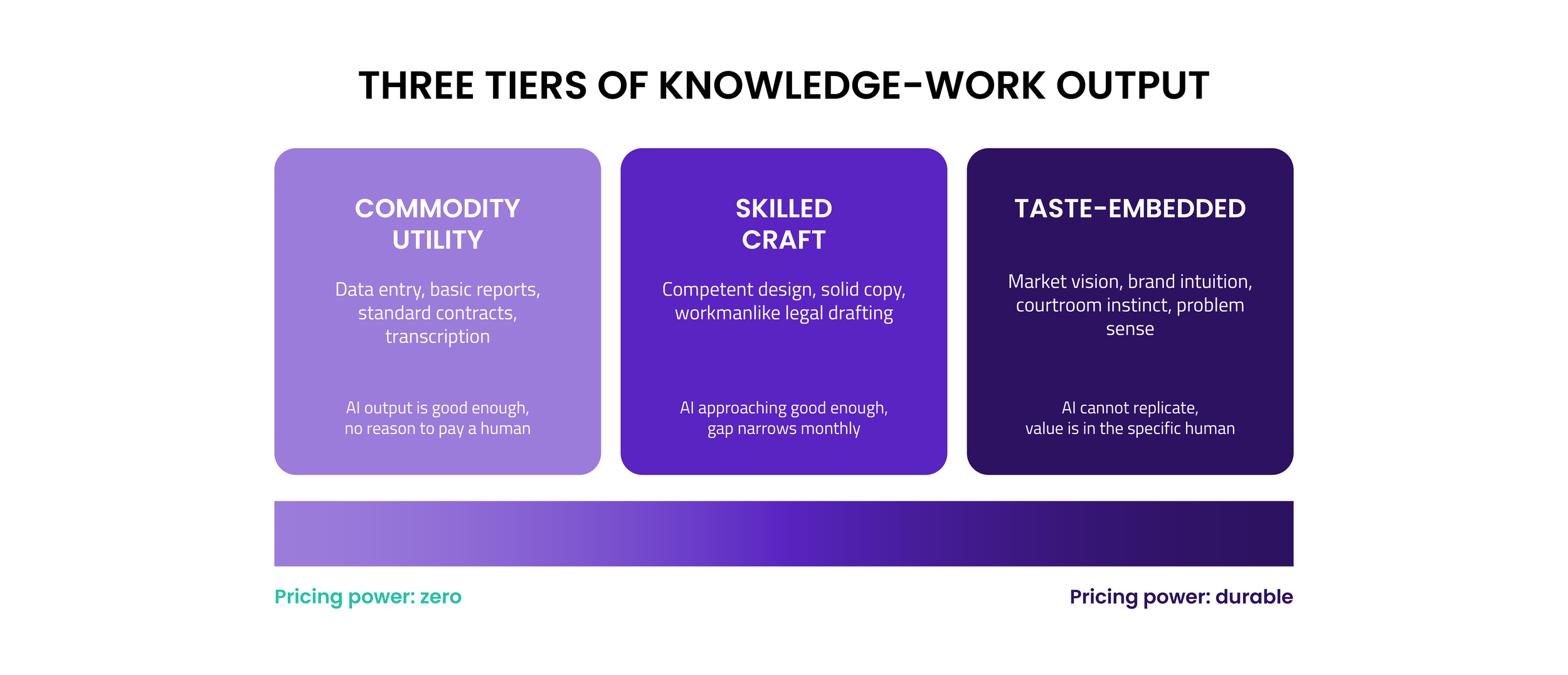
Figure 1: Three tiers of knowledge-work output. AI’s impact varies dramatically across tiers.
At the bottom, commodity utility output (data entry, standard financial reports, basic legal documents, transcription, routine correspondence) is where AI is already good enough. No client will pay a professional rate for work a machine does acceptably at trivial cost. The scarcity is gone.
In the middle, skilled craft output (competent website design, solid marketing copy, workmanlike legal drafting, mid-tier consulting analysis) is where AI is approaching good enough, and the gap narrows every month. Most knowledge professionals operate here. This is also where anxiety runs highest, because these professionals can see the water rising.
At the top, taste-embedded output resists automation entirely. Any first-year analyst today has more raw power than Warren Buffett in his prime: more information sources, better modeling tools, 24-hour reporting on companies. Buffett, however, sees things almost all analysts never will. When he read Geico’s financials in 1951, or recognized Coca-Cola’s brand as an unassailable moat in 1988, he was not doing more efficient analysis. He was doing categorically different work. This type of insight has yet to be replicated, or trained, despite countless efforts and costly MBAs.
AI commoditizes utility output. It does not commoditize taste-embedded output, because taste is not a production process. It is an accumulation of judgment that expresses itself through choices no algorithm can reverse-engineer.
The Core Shift: From Production to Certification
AI made production cheap. Certification is still expensive. Everything else in this article follows from that.
In the traditional model, value accrued to the party that could produce reliable output: the firm that could research, analyze, draft, and deliver under deadline at acceptable risk. AI dismantles that structure. It makes the production layer cheap and abundant, while leaving the consequences of errors fully intact. The scarce resource is no longer the ability to do the work. It is the willingness to bear personal consequences for the work’s correctness.
A machine can generate an audit workpaper. It cannot sign the audit opinion. It cannot be disciplined by a professional body, sanctioned by a regulator, or sued for malpractice. As AI handles more of the production, the humans who certify, sign, and stand behind the output become more valuable, not less. The fewer people needed for production, the higher the margin on certification.
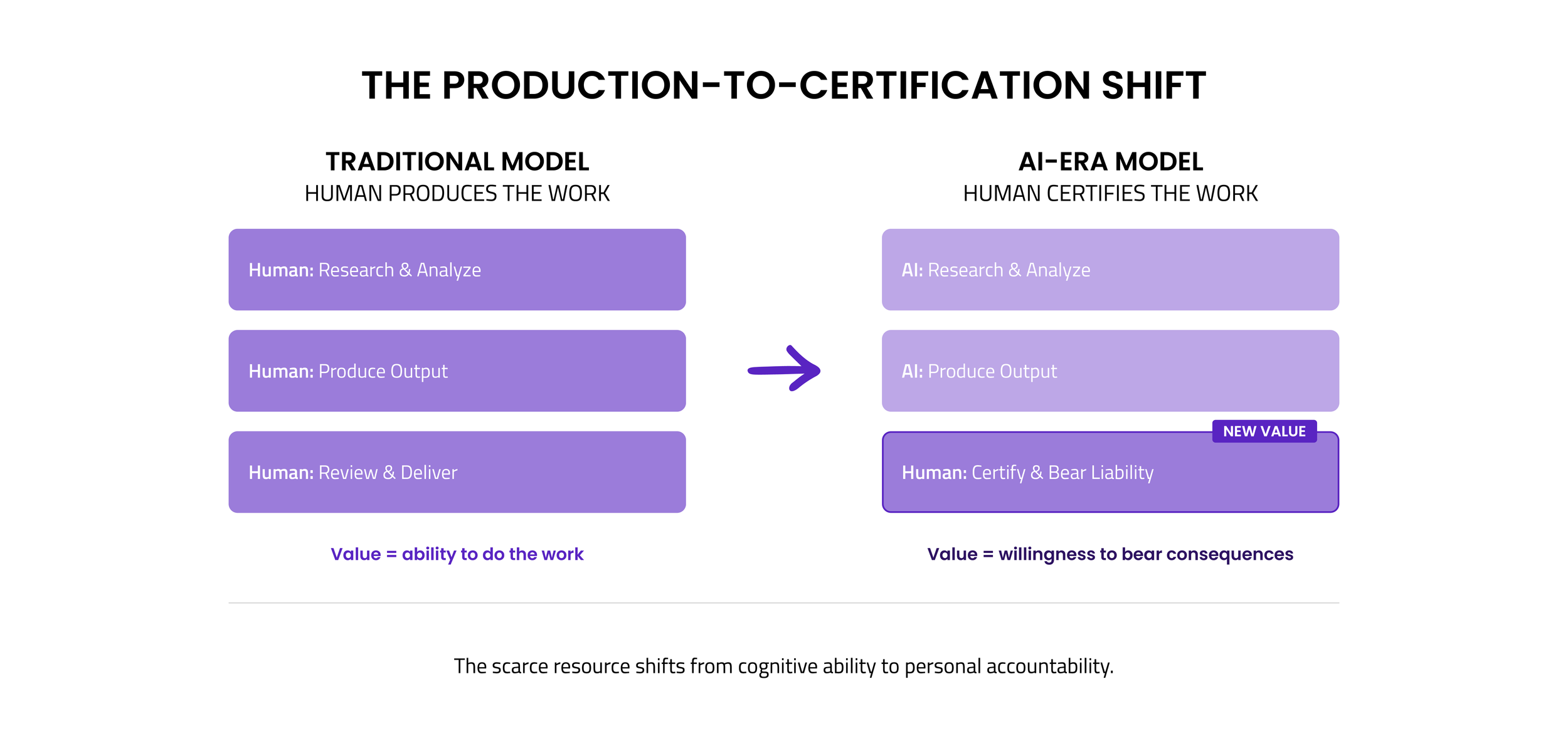
Figure 2: The scarce resource shifts from cognitive ability to personal accountability.
Professional pyramids are shrinking at the base. While the proportion of law firm associates fell from 44.5% to 40.2% over the last fifteen years, generative AI is now accelerating this collapse. Headcount at the bottom is compressing because firms no longer require a fleet of juniors for first draft production. This shift allows margins to expand even as the price of routine work declines. The labor cost of production is falling faster than the market price for senior level certification. PwC provides a clear example; the firm aims to reduce junior hiring by one third by 2028. In this new economy, drafting and synthesis are commodities. Senior roles remain valuable because human judgment and legal accountability are the only remaining scarcities..
Five Sources of Durable Scarcity
Certification can take five forms, each of which represents a source of pricing power that persists when production costs approach zero.
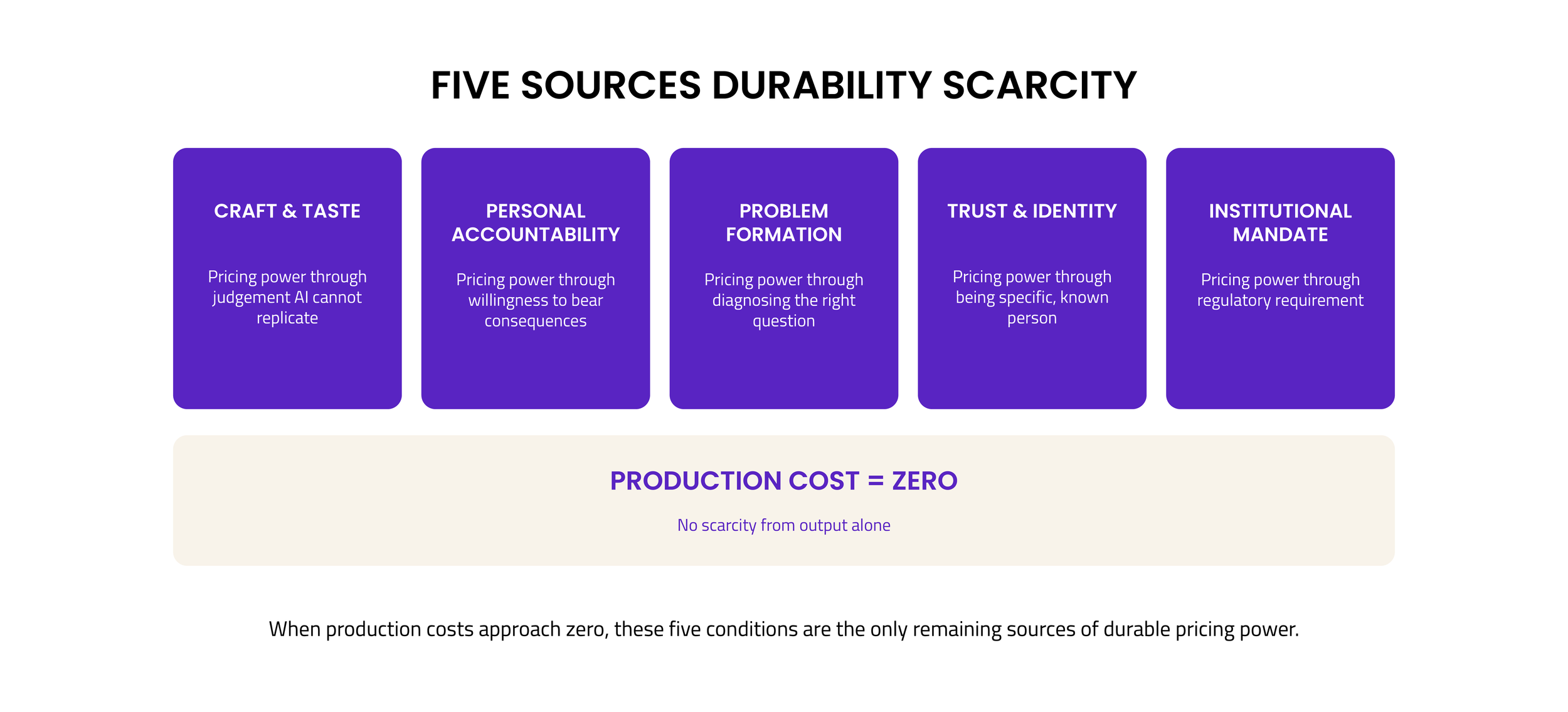
Figure 3: When production costs zero, these five conditions are the only remaining sources of durable pricing power.
1. Craft and Taste
In any field, there is a difference between producing something functional and producing something that reflects hard-won discernment. In knowledge work, that discernment appears as strategic intuition, market vision, and interpretive skill built through experience and expressed through choices that cannot be reduced to a prompt. As competent output becomes ubiquitous, differentiated judgment becomes more valuable. The strategic implication: price around the decisions that shape outcomes, not around standardized deliverables.
2. Personal Accountability
Certification is not review. It is responsibility. A CPA’s signature has always been valuable. In the AI economy it becomes more valuable, because AI generates the workpapers but cannot sign the opinion. When errors carry meaningful consequences, the willingness to bear those consequences becomes scarce. The strategic directive: stop selling what you produce. Start selling what you are willing to be held accountable for.
3. Problem Formation
AI performs well when the task is clear. It struggles when the problem is not yet defined. The highest-value advisory work is often not solving a known problem but identifying the right one: the problem behind the problem. This is when a “marketing issue” becomes a positioning problem, or a “growth slowdown” is revealed as a trust deficit in the product. When AI handles downstream analysis, upstream diagnosis becomes the scarce capability. In many contexts, knowing how to write the AI prompt is the work.
4. Trust and Identity
AI agents are interchangeable. They have no history, no continuity, no reputational skin in the game. The counterparty matters in consequential decisions: selling a company, restructuring an organization, allocating capital. The value lies in the outcome and the reputational collateral attached to the person providing it. Leaders should treat trust and continuity not as soft factors but as assets that sustain pricing power when output becomes abundant.
5. Institutional Mandate
Regulation, licensing, and professional standards change more slowly than technology. Courts require licensed attorneys. Audits require certified accountants. Many clinical decisions require credentialed professionals. These requirements create durable scarcity because the supply of licensed humans grows slowly while the demand for certification of machine-generated work grows quickly. If you operate in a regulated knowledge profession, your license is becoming your most valuable asset. Protect it, leverage it, and price around it.
The Audit: Five Questions to Ask
Most organizations now operate across two modes of work: Data gathering, analysis, drafting, modeling, and execution, production, is rapidly moving into the AI model, where productivity rises and the work commoditizes. The other, where value is shifting towards, is certification: the human responsibility for judgment, trust, and decisions. A consulting firm may automate slide production, but its boardroom judgment still carries the risk. A financial planner’s modeling may commoditize, but the fiduciary relationship remains. A marketing agency’s campaign execution can be automated; brand judgment still depends on people.
The professionals who recognize this split and deliberately migrate their time toward the human-regime activities will build durable careers. The ones who keep spending most of their time on production will find that time worth less every quarter.
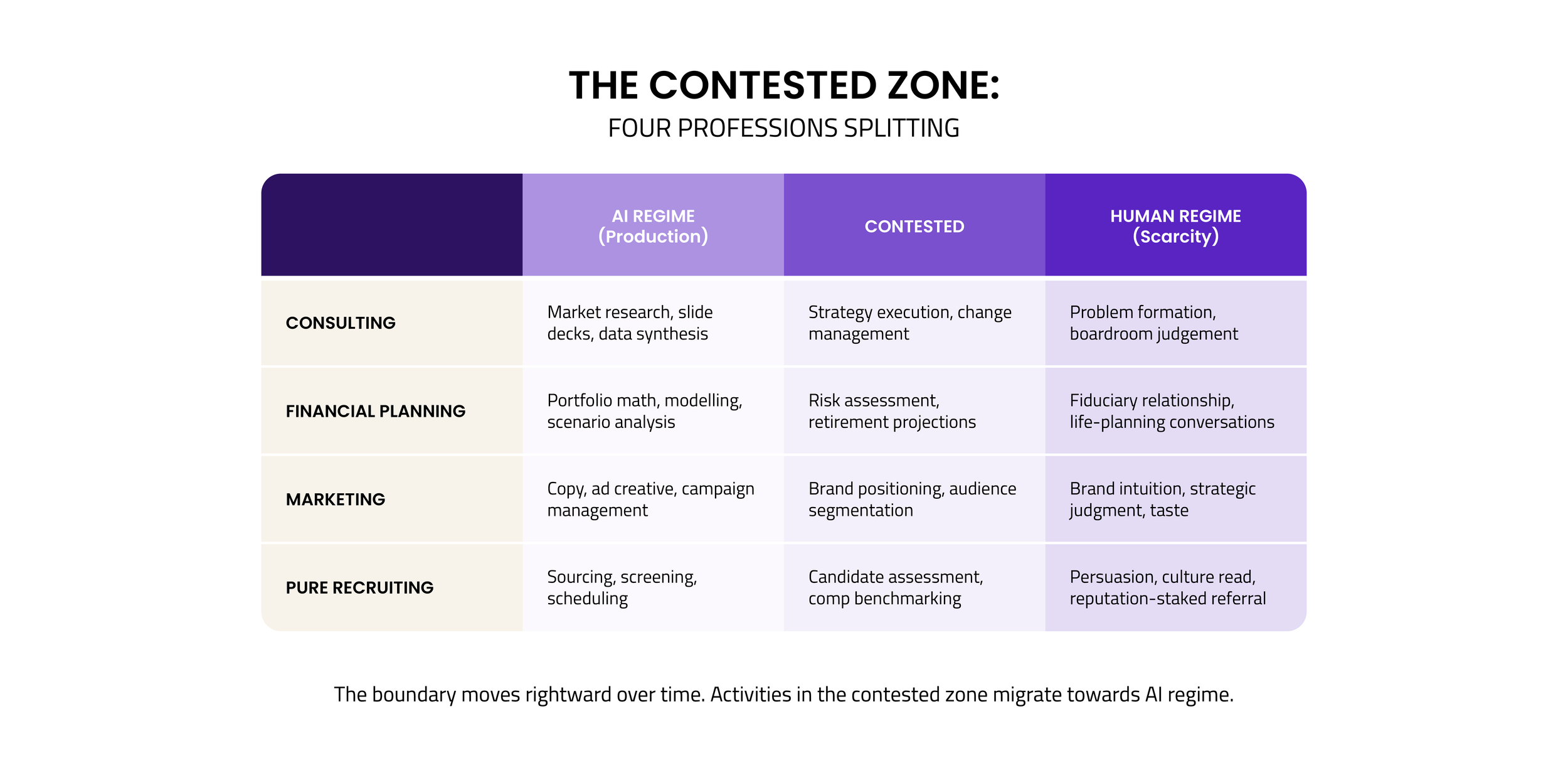
Figure 4: Four contested-zone professions splitting along the same fault line. The boundary moves rightward over time.
Here is how to apply this framework. List every activity from last week that generated revenue or served a client. Be specific. Not “marketing consulting” but “built a competitive analysis deck,” “led a strategy session with the CEO,” “wrote three blog posts for a client,” “reviewed and corrected a junior associate’s AI-generated deliverable.”
Score each activity on a scale of 1 to 5:
1. Could AI produce this output at 80% of the quality? (1 = no, 5 = easily)
2. If this work contained a serious error, would it carry personal consequences for me? (1 = no real consequences, 5 = severe)
3. Was the problem well-defined before I started, or did I have to discover it? (1 = I had to discover it, 5 = it was handed to me clearly)
4. Does the client care that I specifically did this? (1 = it had to be me, 5 = anyone would do)
5. Does a regulation or institutional norm require a human? (1 = yes, strictly, 5 = no requirement)
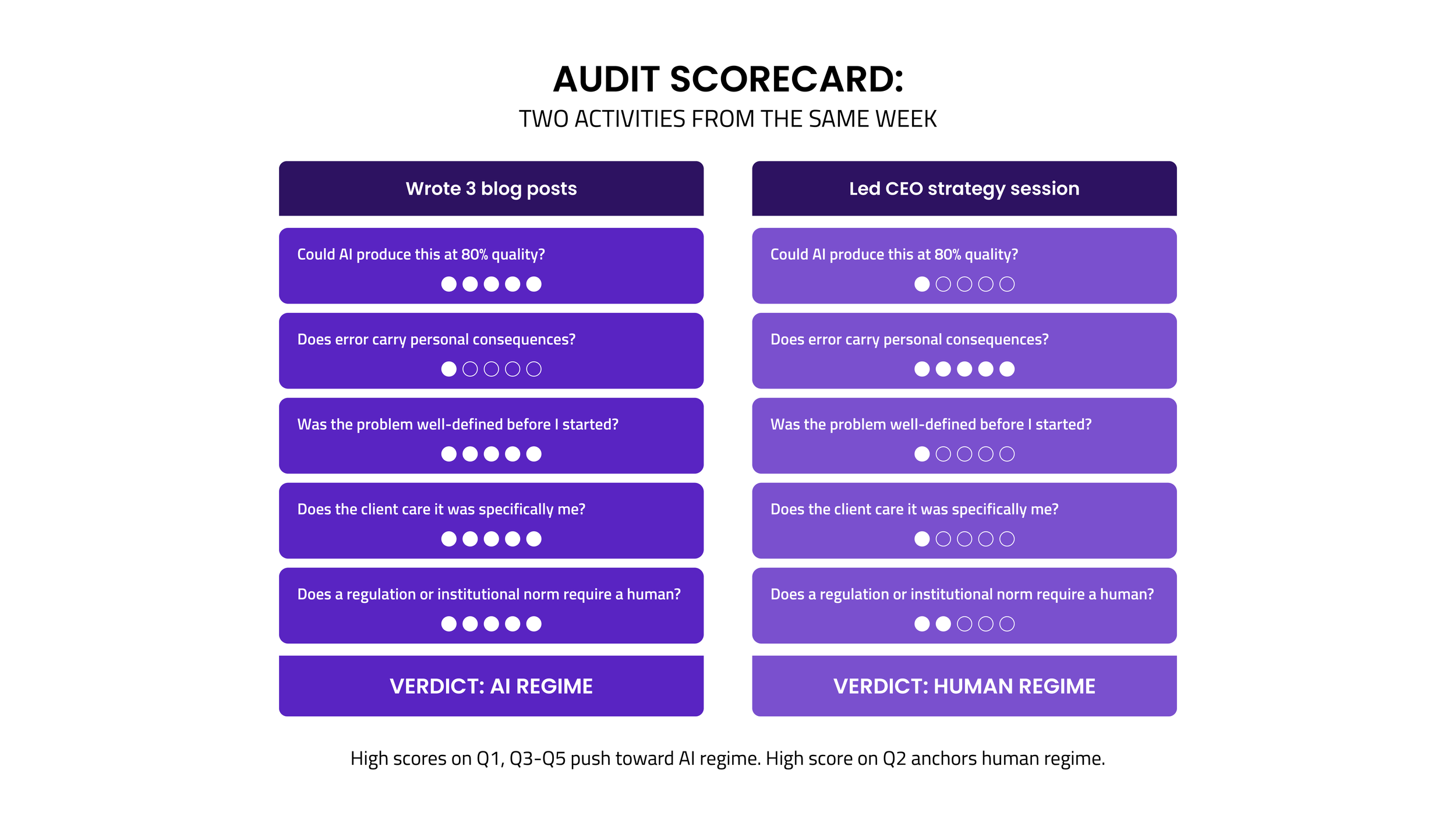
Figure 5: Two activities from the same week. One is deep in the AI regime. The other is anchored by multiple scarcity conditions.
Activities that score high on question 1, high on questions 3 through 5, and low on question 2 are in the AI regime. Activities that score low on question 1, high on question 2, and low on questions 3 through 5 are anchored by scarcity conditions. Everything in between is contested.
Now calculate your time split. What percentage of your revenue-generating time last week fell into each category? If more than half is in the AI regime, the urgency is real. That portion of your work is on a countdown measured in months, not years.
The final step is a decision. Pick the single AI-regime activity consuming the most of your time. Either automate it or stop offering it. Then pick the single activity where you are most anchored by scarcity conditions and ask: how do I do more of this? How do I price and position it so that clients understand they are paying for my judgment and accountability, not my output?
What Leaders Should Do Next
If you find yourself scoring poorly on the audit, there are three concrete moves that accelerate the production-to-certification shift:
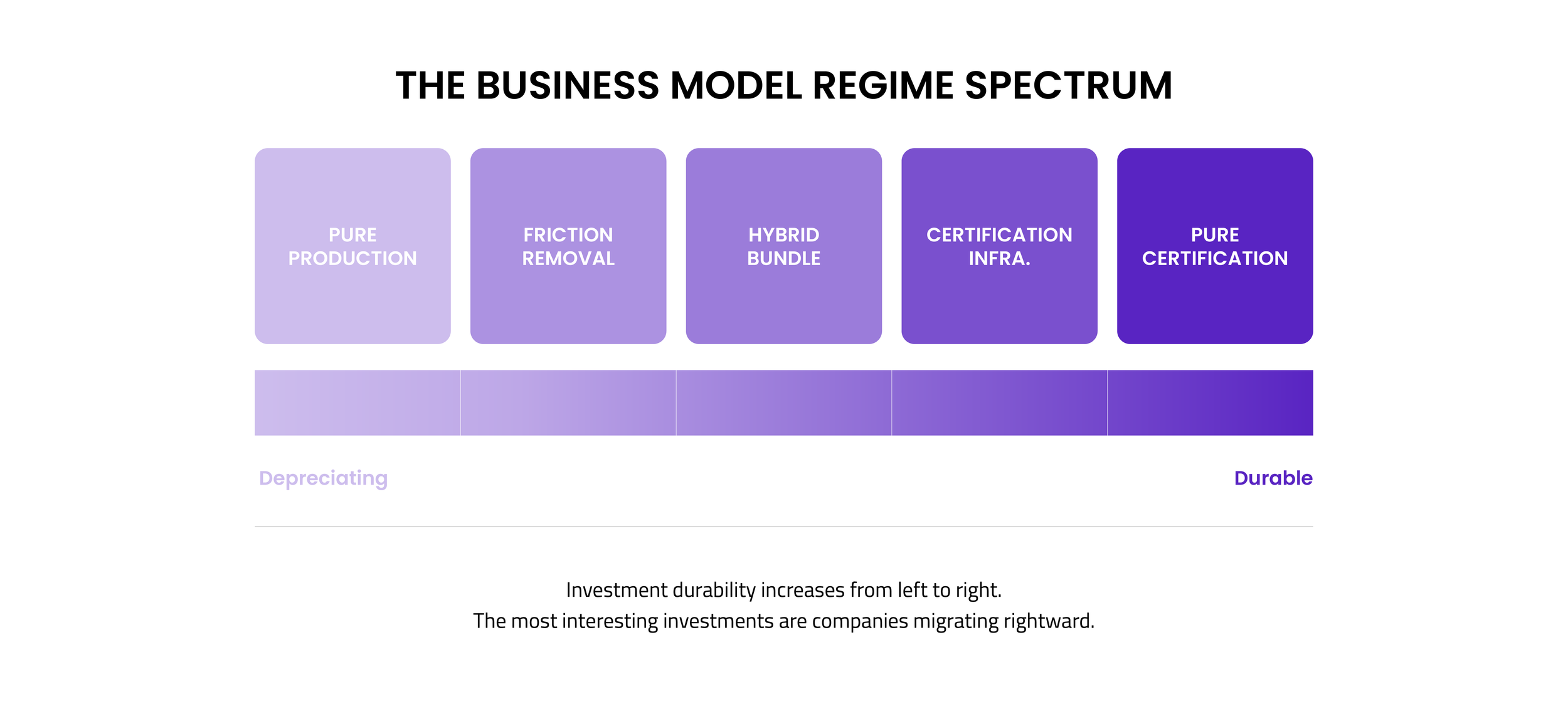
Figure 6: Investment durability increases from left to right. The most interesting positions are companies migrating rightward.
Reprice away from deliverables and toward consequences. If the work is easily produced, pricing based on production will face pressure. Pricing based on validated correctness, risk reduction, and decision ownership is more durable.
Redesign roles around review, escalation, and sign-off. Many knowledge organizations still staff for production. The new bottlenecks are quality assurance, exception handling, and accountable decision rights. Invest in the layers that certify work, not the layers that generate first drafts.
Separate production systems from certification systems. Trying to preserve a production business model while adopting AI produces confusion: teams optimize for speed while clients demand accountability. Build explicit pathways. Automation for commodity production. Human-in-the-loop certification for consequential outputs.
What Sarah Finally Saw
Six months after that call with Ray, Sarah called him again.
“I stopped selling website builds as a standalone service. I let a junior handle the production. I’m pricing my time around the strategy, the positioning work, the oversight.”
“And?”
Ray asked.
“Headcount went from three to one. Revenue dropped a third in the first quarter and recovered by the third. Margin doubled.”
“You stopped competing with tools.”
“I stopped competing with tools.”
Sarah’s window existed because most practitioners in her space had not yet made this transition. They were still producing, still competing on output quality and turnaround time against a technology that produces faster and cheaper every month. That window will not stay open forever.
Not Doom. Clarity.
The old rules are not wrong. They are a special case. They still apply wherever craft, accountability, problem formation, trust, or institutional mandate creates scarcity. In those domains, the competitive playbook that has worked for decades continues to work, modified for a world where AI handles production, but humans still certify, interpret, relate, and bear consequences.
The common mistake is treating AI disruption as a uniform force that either threatens everything or threatens nothing. It is neither. It is a boundary condition. The task is to determine which side of that boundary your work occupies, and to restructure before the boundary moves past you.
Revenue anchored in scarcity conditions becomes less substitutable, less labor-linear, and more durable. That is the combination capital markets reward with structurally higher valuations.
The strategic task for every knowledge-intensive organization is to locate each activity on that boundary and reallocate time, pricing, and operating model toward the sources of scarcity.
[1]Sarah is a composite character drawn from interviews with agency owners conducted by the authors. Her name and identifying details have been altered.